Introduction
Welcome to my corner! This week, I'm sharing my thoughts on the film Psycho. Another perfect film for spooky season with perhaps the most iconic scene in a horror/thriller movie ever—the famous shower scene. Enjoy!
Psycho
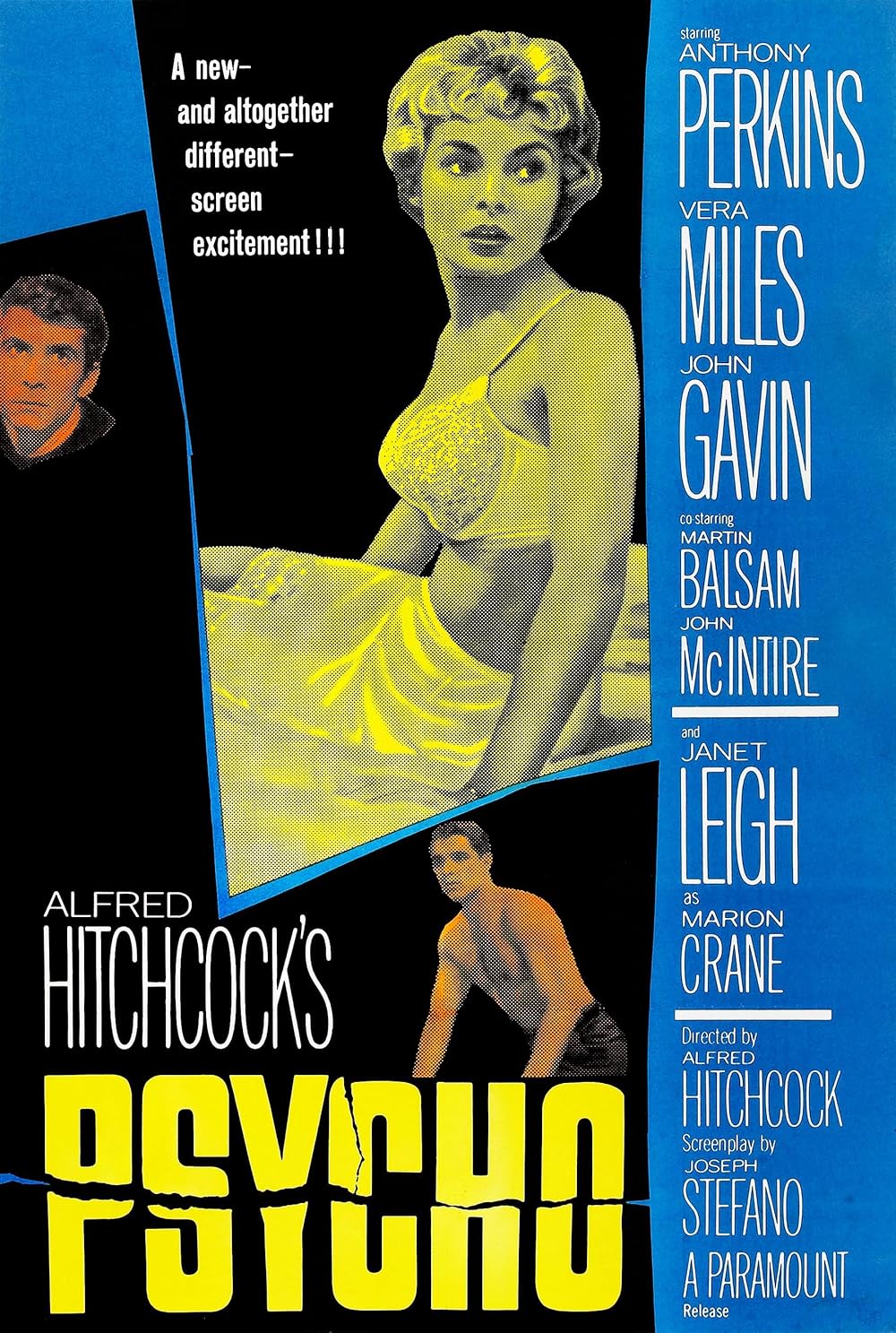
Psycho is a 1960 American horror thriller film produced and directed by Alfred Hitchcock. The screenplay, written by Joseph Stefano, is based on the 1959 novel by Robert Bloch. The film stars Anthony Perkins, Janet Leigh, Vera Miles, John Gavin, and Martin Balsam. The plot centers on an encounter between on-the-run embezzler Marion Crane (Leigh), shy motel proprietor Norman Bates (Perkins), and his disturbed mother. A private investigator (Balsam), Marion's lover Sam Loomis (Gavin), and her sister Lila (Miles) investigate Marion's subsequent disappearance.
Psycho was seen as a departure from Hitchcock's previous film, North by Northwest (1959), as it was filmed on a small budget in black-and-white by the crew of his television series Alfred Hitchcock Presents. Initially the film divided critics due to its controversial subject matter, but audience interest and outstanding box-office returns prompted a major critical re-evaluation. Psycho was a massive commercial success; with a budget of US $806,947 (equivalent to $8.8 million in 2025), the film earned $50 million (equivalent to $544 million in 2025) at the box office worldwide, not including the revenue from rentals. Psycho was nominated for four Academy Awards, including Best Director for Hitchcock and Best Supporting Actress for Leigh.
Psycho is now considered one of Hitchcock's best films and is arguably his most famous and influential work. It has been hailed as a major work of cinematic art by international film critics and scholars who praise its slick direction, tense atmosphere, impressive camerawork, memorable score, and iconic performances. Additionally the shower scene has become one of the best-known scenes in all of cinema. It is regarded as "the most heavily analyzed film in the long career of the most investigated director in the history of American film" and is often ranked among the greatest films of all time. It set a new level of acceptability for violence, deviant behavior, and sexuality in American films, and it has been considered to be one of the earliest examples of the slasher film genre. After Hitchcock's death in 1980, Universal Pictures produced follow-ups: three sequels, a remake, a made-for-television spin-off, and a television series. In 1992, the Library of Congress deemed the film "culturally, historically, or aesthetically significant" and selected it for preservation in the United States National Film Registry.
Plot: Phoenix secretary Marion Crane (Janet Leigh), on the lam after stealing $40,000 from her employer in order to run away with her boyfriend, Sam Loomis (John Gavin), is overcome by exhaustion during a heaving rainstorm. Traveling on the back roads to avoid the police, she stops for the night at the ramshackle Bates Motel and meets the polite but highly strung proprietor Norman Bates (Anthony Perkins), a young man with an interest in taxidermy and a difficult relationship with his mother.
Acting: My favorite title is Psycho for the following actors, if not stated otherwise.
Anthony Perkins played Norman Bates. His four most notable titles are The Trial, and the Psycho film franchise.
Janet Leigh played Marion Crane. She's Jamie Lee Curtis' mother if you didn't already know that. Her four most notable titles include Touch of Evil, The Fog, Psycho, and The Manchurian Candidate. My favorite is Holiday Affair.
Vera Miles played Lila Crane. Her four most notable titles are The Man Who Shot Liberty Valance, the Wrong Man, Psycho, and The Searchers.
John Gavin played Same Loomis. His four most notable titles are Spartacus, A Time to Love and a Time to Die, Psycho, and Thoroughly Modern Millie.
Martin Balsam played Private Investigator Milton Arbogast. His four most notable titles include All the President's Men, 12 Angry Men, Psycho, and The Taking of Pelham One Two Three. 12 Angry Men is my favorite.
Minor roles were played by John McIntire as Deputy Sheriff Al Chambers; Simon Oakland as Dr. Richman; Frank Albertson as Tom Cassidy; Pat Hitchcock as Caroline; Vaughn Taylor as George Lowery; Lurene Tuttle as Mrs. Chambers; John Anderson as California Charlie; Mort Mills as Highway Patrol Officer; Virginia Gregg, Paul Jasmin, and Jeanette Nolan make uncredited appearances as the voice of Norma "Mother" Bates. The three voices were used interchangeably, except or the speech in the final scene, which was performed entirely by Gregg.
Background information from the American Film Institute (AFI): A Dec. 27, 1959 New York Times (NYT) news item reported that director Alfred Hitchcock, in order to protect the film's plot twists, deliberately withheld the title of the Robert Bloch novel on which the film was based, until "an alert reported triumphantly [and incorrectly] revealed it" as Psyche.
Hitchcock makes his customary cameo in Psycho near the beginning of the film, when "Marion Crane" returns to her office after her afternoon rendezvous with "Sam Loomis." Hitchcock appears as a man wearing a cowboy hat, standing on the sidewalk outside Marion's office.
The film is largely faithful to Bloch's novel Psyho, with several notable exceptions. In the book, Norman is a plump, balding forty-year-old who drinks to excess and blacks out, thereby allowing the Mother side of his personality to take over. For the film, Norman was written as a younger, more attractive, more vulnerable character, coinciding with the casting of Anthony Perkins in the role. The violence in the book is also more extreme, with Mother completely severing Mary's head during the shower murder (the female protagonist's name was changed from Mary to Marion for the film). Norman's mental illness is also more pronounced in the book, with the psychiatrist suspecting that Norman had an incestuous relationship with his mother and that he was a "secret transvestite long before Mrs. Bates had died." In the novel, Norman had been institutionalized for a few months after secretly poisoning his mother and her lover, and Dr. Steiner (changed to Dr. Richmond for the film) explains that Norman had three separate personalities representing himself as a child clinging to his mother; as his mother who still dominated him; and himself as an adult, able to cope with the outside world. After the film was released, a condensed version of Bloch's novel was published in Cavalier magazine in Aug 1960.
Bloch's Norman Bates was partially based on real-life killer Ed Gein (1906—1984). Gein, who lived on a farm near the rural town of Plainfield, Wis., was arrested in 1957 after the body of a local woman was found in his barn. Although Gein confessed to only two murder, he was suspected of several more, and his home was found to contain numerous gruesome objects, such as masks made from human skin, most of which he had obtained by robbing graves. After being judged criminally insane, Gein was incarcerated in a mental institution until his death. In a 1987 obituary for the judge who presided over Gein's case, it was reported that in a 1984 interview, Bloch, who was living in a nearby town when Gein's crimes were discovered, said that it was not Gein's actions that inspired him to write Psycho as much as the fact that a psychotic murderer could be living in a small town without anyone being aware of his crimes. Gein was also the basis for several other villains, including "Leatherface" in the 1974 film The Texas Chain Saw Massacre and "Buffalo Bill" in the 1988 novel and 1991 movie The Silence of the Lambs. Roberts Blossom portrayed Gein, disguised as "Ezra Cobb," in the 1974 film Deranged.
According to the Paramount Collection, located at the AMPAS Library, Paramount considered purchasing the rights to Bloch's book in Feb 1959, but the reader who synopsized the advance copy submitted to the studio called novel "too repulsive for films, and rather shocking even to a hardened reader."
Modern sources add that Hitchcock bid for the screen rights to Bloch's book anonymously through agent Ned Brown of the Music Corporation of America (MCA) talent agency, while the director's papers confirm that he purchased the screen rights for just $9,000. Bloch did not learn the identity of the actual buyer until after the deal had been finalized. In modern interviews, Hitchcock claimed that he was interested in the book primarily because of the suddenness of the murder in the shower.
Modern sources have claimed that Paramount was deeply reluctant to finance production of the picture due to its controversial subject matter, which forced Hitchcock to seek cost-cutting measures wherever possible. One of the ways in which Hitchcock sought to lower the budget was to shoot the picture primarily with the crew he used for his acclaimed television series, Alfred Hitchcock Presents, as they were used to working under strict time constraints and for smaller budgets. In order to keep down production costs, Hitchcock voluntarily deferred his directing fee in exchange for ownership of sixty percent of the picture, according to a Sep 1960 Variety (Var) report.
Final Thoughts: Psycho is the pinnacle horror thriller film. I'm not generally a horror/thriller movie fan, but Psycho is so iconic that one cannot call themselves a film buff without having seen this movie. So, if you claim to be a horror/thriller film genre fan or a movie buff, then you absolutely must watch this movie if you haven't already seen it.
Side notes: Where exactly was Marion planning to go? It was pretty obvious to all involved that she ran off with the money. She didn't make any attempts to hide it other than running away, which didn't help. I have to assume she would have gotten caught eventually anyway if she hadn't decided to stay at the Bates Motel.
It's funny that they waited until after Alfred Hitchcock was dead to make any sequels to Psycho. I wasn't even aware there were sequels. I'm sure the film company's waited for Hitchcock's death because they knew he wouldn't make a sequel.
My favorite scene was the shower scene, obviously.
My favorite quote is "Headaches are like resolutions. You forget them as soon as they stop hurting." —Marion Crane.
Rated: R
Where to watch it: According to Google, Psycho is currently available on Netflix, Peacock, The Roku Channel, and Amazon Prime Video with a subscription. You can also purchase or rent a digital copy for a few dollars. I've also donated a DVD copy of the film to the Emil M. Larson Public Library in Clark for you all to enjoy if you choose to.