Introduction
Welcome to my corner! This week, I'm sharing my thoughts on the film Strangers on a Train. The TCM television channel played Strangers on a Train as part of their 'Celluloid Closet Classics' lineup (a special theme for Pride Month) on June 30. Enjoy!
Strangers on a Train
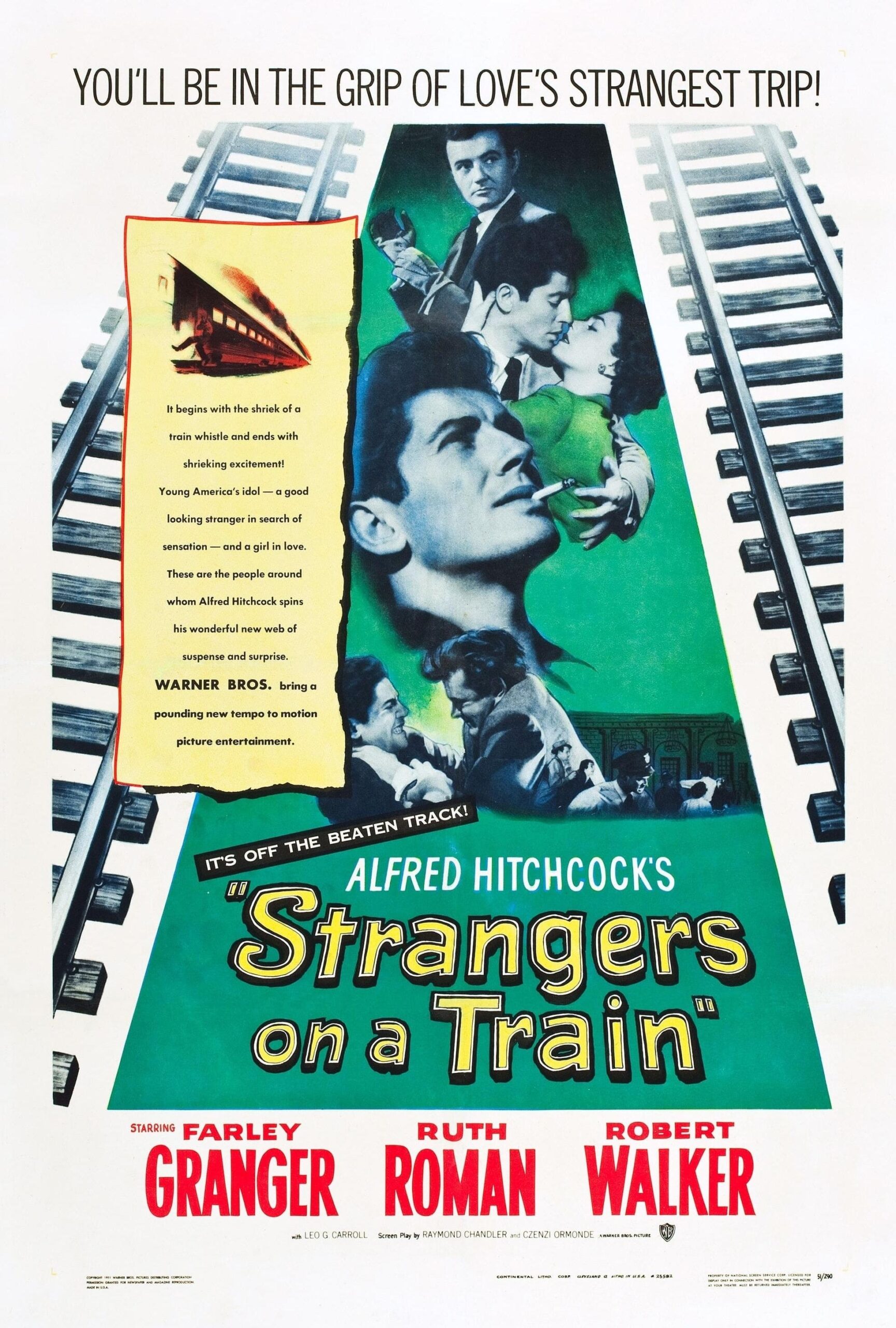
Strangers on a Train is a 1951 American psychological thriller film noir produced and directed by Alfred Hitchcock, screenplay by Raymond Chandler and Czenzi Ormonde based on the 1950 novel of the same name by Patricia Highsmith. It was shot in late 1950, and released by Warner Bros. on June 30, 1951, starring Farley Granger, Ruth Roman and Robert Walker.
The story concerns two strangers who meet on a train, one of whom is a psychopath who suggests that they "exchange murders so that neither will be caught. The film initially received mixed reviews, but has since been regarded much more favorably. In 2021, the film was selected for preservation in the United States National Film Registry by the Library of Congress as being "culturally, historically, or aesthetically significant."
Plot: In Alfred Hitchcock's adaptation of Patricia Highsmith's thriller, tennis star Guy Haines (Farley Granger) is enraged by his trampy wife's refusal to finalize their divorce so he can wed senator's daughter Anne (Ruth Roman). He strikes up a conversation with a stranger, Bruno Anthony (Robert Walker), and unwittingly sets in motion a deadly chain of events. Psychopathic Bruno kills Guy's wife, then urges Guy to reciprocate by killing Bruno's father. Meanwhile, Guy is murder suspect number one.
Acting: Robert Walker played Bruno Antony. What a creepy fellow. Walker played the part fantastically. Strangers on a Train was to be one of his last films. He died in 1951, the same year Strangers on a Train was released. His four most notable titles are The Clock, Till the Clouds Roll By, Strangers on the Train and Bataan.
Farley Granger played Guy Haines. He was a good opposite for Walker to play against. His four most notable titles are Rope, Side Street, Strangers on a Train and The North Star.
and the women: Ruth Roman played Anne Morton. Other than being Guy's love interest, she didn't play that big of a role in this movie. Patricia Hitchcock played Barbara Morton. She was a lot of fun. I wish she had a bigger role in the movie. She reminded me of modern true crime fans. Kasey Rogers played Miriam Joyce Haines. She's the woman that's murdered. She acted the part well, I did not sympathize with her character.
Technical Aspects: Hitchcock secured the rights to the Patricia Highsmith novel for just $7,500 since it was her first novel. As usual, Hitchcock kept his name out of the negotiations to keep the purchase price low. Highsmith was quite annoyed when she later discovered who had bought the rights for such a small amount.
One of the most memorable single shots in the Hitchcock canon—it "is studied by film classes", says Kasey Rogers, who played Miriam—is her character's strangulation by Bruno on the Magic Isle. "[I]n one of the most unexpected, most aesthetically justified moments in film," the slow, almost graceful, murder is shown as a reflection in the victim's eyeglasses, which have been jarred loose from her head and dropped to the ground. the unusual angle was a more complex proposition that it seems. First Hitchcock got the exterior shot in Canoga Park, using both actors, then later he had Rogers alone report to a soundstage where there was a large concave reflector set on the floor. The camera was on one side of the reflector, Rogers was on the other, and Hitchcock directed Rogers to turn her back to the reflector and "float backwards, all the way to the floor... like you were doing the limbo." The first six takes went badly—Rogers thudded to the floor with several feet to go—but on the seventh take, she floated smoothly all the way. Hitchcock then had the two elements "ingenious[ly]" double printed, yielding a shot of "oddly appealing originality [with] a stark fusion of the grotesque and the beautiful... The aestheticizing of the horror somehow enables the audience to contemplate more fully its reality."
Hitchcock was, above all, the master of great visual set piece, and "'[p]erhaps the most memorable sequence in Strangers on a Train is the climactic fight on a berserk carousel." While Guy and Bruno fight, the ride runs out of control until it tears itself to pieces, flinging wooden horses in to the crowd of screaming mothers and squealing children. "The climactic carousel explosion was a marvel of miniatures and background projection, acting close-ups and other inserts, all of it seamlessly matched and blended under film editor William H. Ziegler's eye."
The explosion is triggered by the attempts of a carnival man to stop the ride after crawling under the whirling carousel deck to get the controls in the center. Although Hitchcock admitted to undercranking the shot (artificially accelerating the action), it was not a trick shot: the man actually had to crawl under the spinning ride, just inches from possible injury. "Hitchcock told me that this scene was the most personally frightening moment for him in any of his films", writes biographer Charlotte Chandler. "The man who crawled under the out-of-control carousel was not an actor or a stuntman, but a carousel operator who volunteered for the job. If the man had raised his head even slightly," Hitchcock said, "it would have gone from being a suspense film into a horror film."
Final Thoughts: I enjoy a good suspense thriller, and Strangers on a Train certainly delivered. Of the few Alfred Hitchcock movies that I've seen thus far, I've enjoyed them all. There's a reason he's a legend of the film industry. He always creates powerful shots, everything has meaning.
At first I though the movie would play out how Bruno wanted it, him killing Miriam, and Guy killing Bruno's father. Hitchcock likes twisted relationships and emotions, I thought it only likely, but that didn't happen. Instead, Guy refuses and is basically stalked and threatened by Bruno for the remainder of the film. Although not what I originally expected, it was still twisted and on-brand for Hitchcock.
The scenes mentioned in the Technical Aspects section were definitely the highlights. The reflection in the glasses during the murder scene was really cool. And the ending carousel scene was hilariously bizarre, but effective just the same.
You definitely need to watch this movie once in your lifetime.
Where to watch it: According to Google, Strangers on a Train is available to watch on Tubi for free. You can also purchase or rent a digital copy for a few dollars. I've also donated a DVD copy of the film to the Emil M. Larson Public Library in Clark for you all to enjoy if you choose to.
That's it for this week! What were your thoughts? Feel free to share them with us! You can call us, email us, visit us at the office, leave us a comment or message on Facebook, or even mail us something. Keep the comments, suggestions, questions, submissions, etc. coming our way! We'd love to hear from you!