
Introduction
Welcome to my corner! This week, I'm sharing my thoughts on the film, One Potato, Two Potato. I recorded it from the TCM television channel on September 12, 2025. I finally got around to watching it recently. Enjoy!
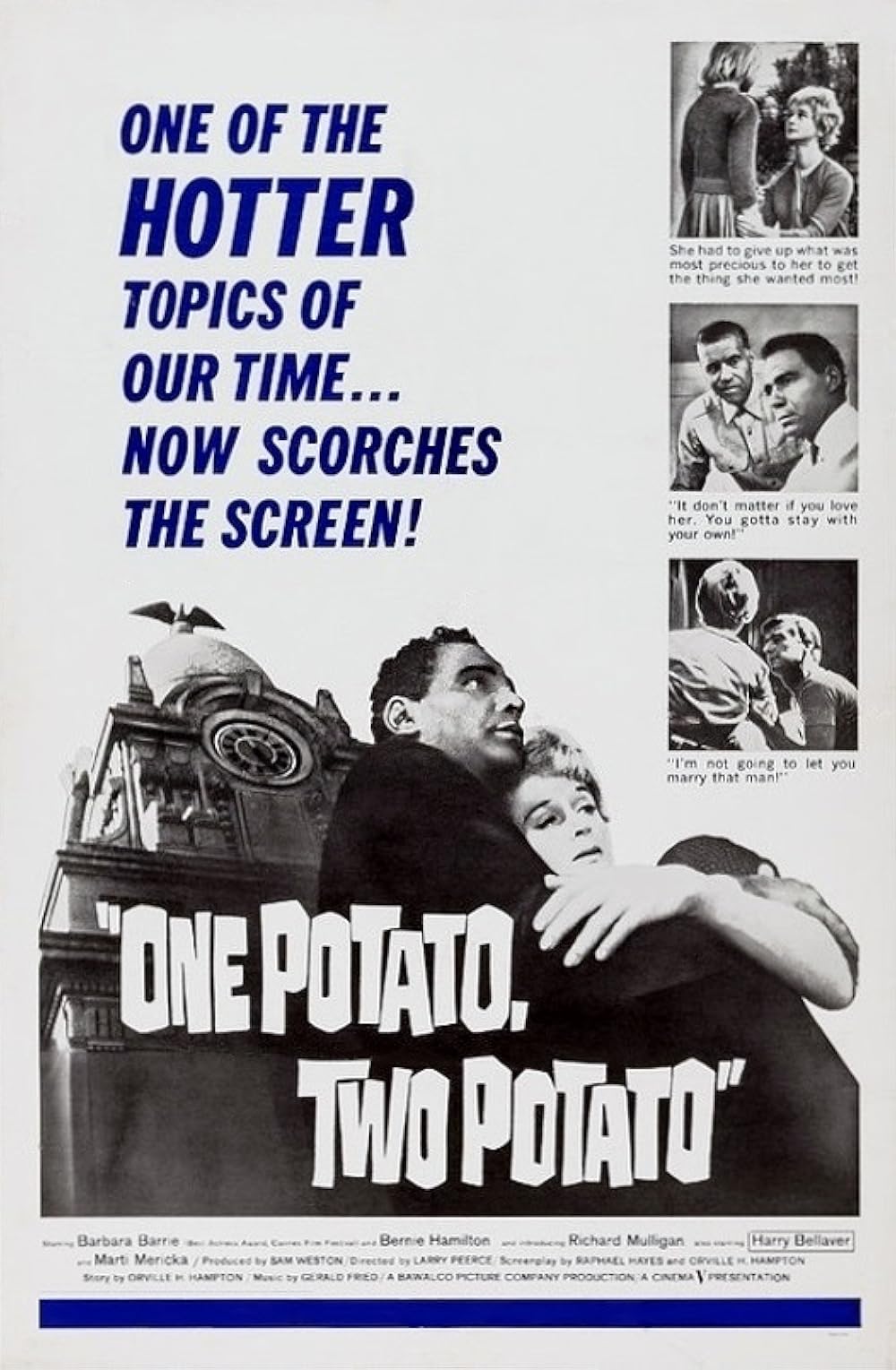
One Potato, Two Potato
One Potato, Two Potato, is a 1964 black-and-white American Peerce and starring Barbara Barrie and Bernie Hamilton. The film centers on an interracial romance and was produced and released at a time when such relationships were rarely openly conducted in the United States and violated the prevailing social norms.
Plot: Julie (Barbara Barrie), a young Midwestern mother, takes all the right steps to assure a promising environment for her newborn daughter. She relocates, gets a job, and secures a legal divorce. When Julie falls in love with Frank (Bernie Hamilton), an African-American man who works at the same factory, her ex-husband, Joe (Richard Mulligan), takes her to court in hopes of getting custody. Frank is advised to flee to keep his new family together, but instead, he confronts the biased system.
Acting: Barbara Barrie played Julie Cullen Richards. Her four most notable titles currently are Breaking Away, One Potato, Two Potato, Hercules and Private Benjamin. She has a long list of credits to her name. My favorite is Hercules.
Bernie Hamilton played Frank Richards. His four most notable titles include Bucktown, The Young One, Hammer and the Starsky and Hutch television series. The only credit I recognize of his is The Dick Van Dyke Show, but he was only in one episode.
Richard Mulligan played Joe Cullen. His four most notable titles are Little Big Man, Oliver & Company and the television series Soap and Empty Nest. Oliver & Company is most certainly my favorite, though I couldn't have told you Mulligan starred in it.
Marti Mericka played Ellen Mary. One Potato, Two Potato was the only movie she ever acted in. I think she did a pretty good job. As an assistant director, her three most notable titles include Fatal Attraction, Nell and the Twin Peaks television series.
Minor roles were played by Robert Earl Jones as William Richards (James Earl Jones' dad!!!); Vinnette Carroll as Martha Richards; Harry Bellaver as Judge Hruska; Faith Burwell as Ann Hruska; Jack Stamberger as The Minister; and Michael Shane as Jordan Hollis.
Technical aspects: Sam Weston was the producer. Larry Peerce was the director. The screenplay was written by Orville H. Hampton and Raphael Hayes. Andrew Laszlo was the cinematographer. Gerald Fried oversaw the music. Robert Fritch was the editor.
One Potato, Two Potato was shot in and around the small city of Painesville in northeastern Ohio.
For her role as Julie Cullen Richards, Barrie won the Best Actress award at the 1964 Cannes Film Festival, in a tie with Anne Bancroft for The Pumpkin Eater.
The screenplay, written by Orville H. Hampton and Raphael Hayes, was nominated for Best Original Screenplay at the 1964 Academy Awards, losing to Father Goose.
The film preceded the more famous Guess Who's Coming to Dinner and the subject of interracial marriage by three years. (I wrote a column on Guess Who's to Dinner last year.)
From TCM: In 1964, Larry Peerce directed a low-budget independent production about the social impact of an interracial marriage in America's Heartland. Titled One Potato, Two Potato, after the children's counting game, the film was released the same year that Congress passed the Civil Rights Act. A network of Civil Rights groups launched a voter registration program in Mississippi, and Martin Luther King Jr. won the Nobel Peace Prize. It was also the year that three Civil Rights volunteers, James E. Cheney, Andrew Goodman and Michael Schwerner, were kidnapped and brutally murdered by the Klan in Mississippi. The film's progressively depicting interracial marriage but also for showing the effect of the relationship on a society that is really only as progressive as its most backward-thinking members.
In the scene in which a judge visits Ellen Mary at school, the girl is having fun with her play group, which includes an African American girl. The fun and games echo the film's opening scene showing the local children playing "One Potato, Two Potato," subtly reminding viewers that kids don't have the level of prejudice that adults do. Racism is not inherent in children; it is a learned behavior. (Ain't that the truth.)
One Potato, Two Potato was independently made outside of the Hollywood studio system, which means it was outside the confines of Hollywood production conventions and practices. The film's location shooting in northeastern Ohio and performances by actors who lacked the glamour and superficial attractiveness of movie stars result in a realism that is the film's greatest strength. The production's low-budget characteristics location shooting, unknown actors, natural lighting and documentary-like black-and-white cinematography actually service the material, rather than retract from it.
Much of the film was shot on real locations in Painesville, Ohio, a working-class town in the northeastern part of the state, roughly 30 miles from Cleveland. While Julie and Frank are getting to know each other, they stroll around the town's main streets, passing by actual local businesses, including small appliance stores, a Hallmark Cards shop, and tiny dress shops.
At first, Frank and Julie fit into Howard, Ohio, just like any other residents with whom they interact and are part of the pleasures and routines of small-town life. However, after they are no longer "ordinary" by the social standards of that time and place; the simple pleasures are denied to them, and their life is anything by routine as they become victims of racial prejudice.
Jones' acting career represented an alternative to the stereotyped roles handed down to African Americans during the Golden Age. During his lengthy career, Jones worked on the stage, starred in Lying Lips in 1939 for independent African American director Oscar Micheaux and then landed small roles in major films in the contemporary era.
Final Thoughts: Holy Mackerel... I'm not sure what else to say. I'm still so shocked by the ending of this movie.
It's crazy for me to think that people, couples, could have such problems just because of the different colors of their skin. I guess I shouldn't be as shocked as I am, considering all the strife within our country now... because of people's skin color.
The idea that a happy, stable biracial family can be broken apart just because of social prejudices is unforgivable. I'm trying my best to no give away the ending, but I may have failed in that respect.
I think everyone should watch this movie, even if it is just to get some perspective. We're all human. At what point did we lost sight of that? Or maybe the better question is, have we ever seen each other as equals? One Potato, Two Potato was made in 1964. At times, it sems like we haven't come very far in the last 60 years.
One Potato, Two Potato wasn't exactly a feel-good movie, so picking a favorite scene is kind of hard for once. I suppose my favorite scene was the one where Ellen and Joe are playing cowboys. It was a sweet scene, but at this point in the movie, she didn't even know that Joe was her biological father.
Similarly, picking out my favorite quote is hard. And, it is not so much a quote as it is part of the ending credits. "The characters and events depicted in this movie pictures are fictitious... The problems presented is real. The legal decision was not invented. It has been rendered in our courts many times."
Where to watch it: According to Google, One Potato, Two Potato is not currently available on any streaming services. But you can purchase or rent a digital copy for a few dollars. I've also donated a DVD copy of the film to the Emil M. Larsson Public Library in Clark for you all to enjoy, if you choose.
That's it for this week! What were your thoughts? Feel free to share them with us! You can call us, email us, visit us at the office, leave us a comment or message on Facebook, or even mail us something. Keep the comments, suggestions, questions, submissions, etc. coming our way! We'd love to hear from you!