
Introduction
Welcome to my corner! This week, I'm sharing my thoughts on the film Mr. Smith Goes to Washington. I recorded it when the TCM television channel played Mr. Smith Goes to Washington as part of their 'Summer Under the Stars - Claude Rains' lineup on August 5. Enjoy!
Mr. Smith Goes to Washington
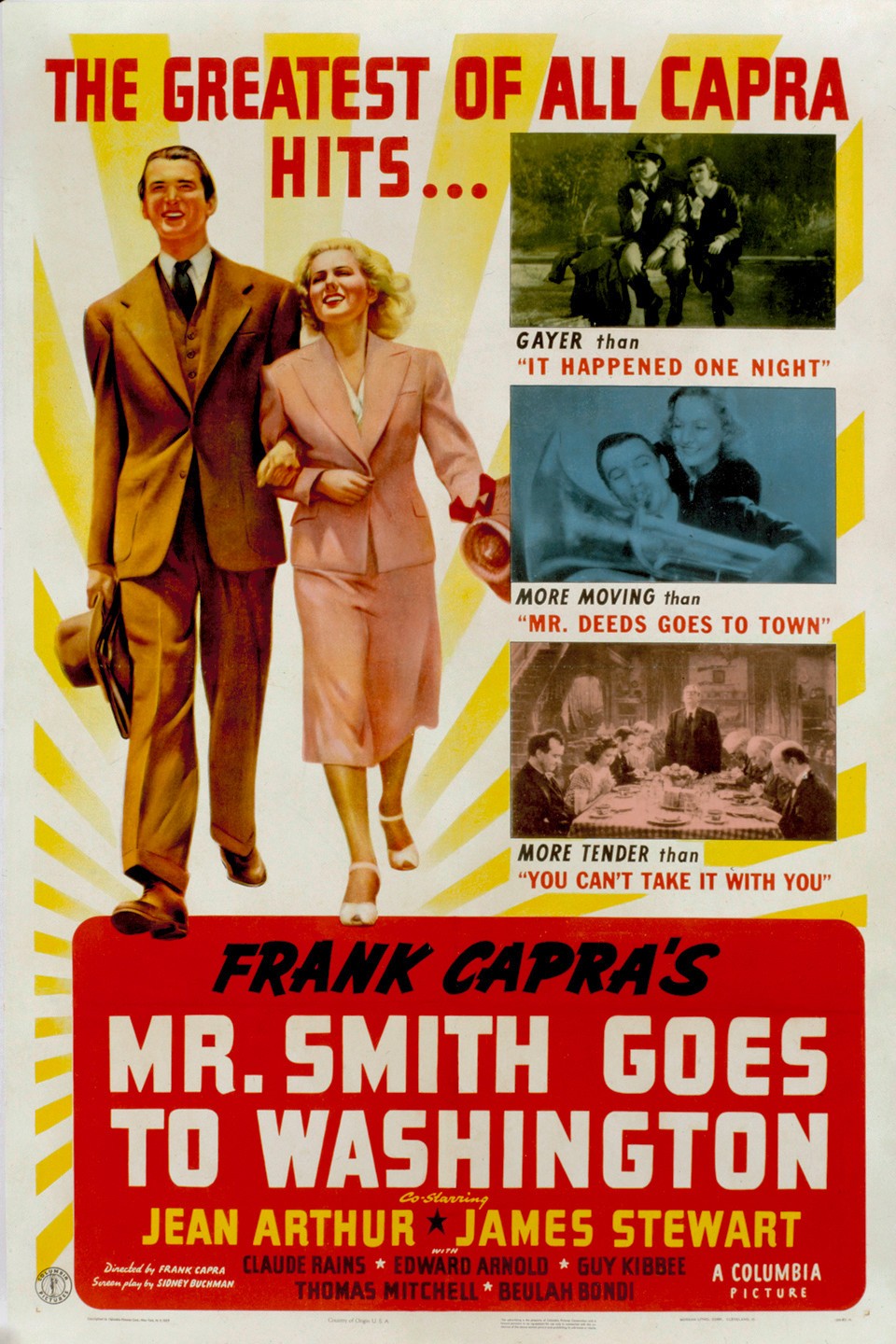
Mr. Smith Goes to Washington is a 1939 American political comedy-drama film directed by Frank Capra, starring Jean Arthur and James Stewart, and featuring Claude Rains and Edward Arnold. The film is about a naive, newly appointed United States senator who fights against government corruption, and was written by Sidney Buchman, based on Lewis R. Foster's unpublished story "The Gentleman from Montana". It was loosely based on the life of Montana U.S. Senator Burton K. Wheeler, who underwent a similar experience when he was investigating the Warren G. Harding administration's Teapot Dome scandal.
The film was controversial in the U.S. when it first released, with many politicians attacking it for bringing Washington into disrepute, but it was very successful at the domestic and international box offices and made Stewart a major star.
Mr. Smith Goes to Washington was nominated for 11 Academy Awards, including Best Picture, Best Director, and Best Actor, and won Best Original Story. Considered to be one of the greatest films of all time, the film was selected by the Library of Congress as one of the first 25 films for preservation in the United States National Film Registry in 1989 for being "culturally, historically or aesthetically significant."
Plot: When the idealistic young Jefferson Smith (James Stewart) winds up appointed to the United States Senate, he gains the mentorship of Senator Joseph Paine (Claude Rains). However, Paine isn't as noble as his reputation would indicate, and he becomes involved in a scheme to discredit Smith, who wants to build a boys' campsite where a more lucrative project could go. Determined to stand up against Paine and his corrupt peers, Smith takes his case to the Senate floor.
Acting: James Stewart played Jefferson Smith. The four films he's known for are: Vertigo, Anatomy of a Murder, It's a Wonderful Life, and Mr. Smith Goes to Washington. Out of all the James Stewart movies I've seen, It's a Wonderful Life is probably still my favorite.
Jean Arthur played Clarissa Saunders. Her four most notable titles are A Foreign Affair, The More the Merrier, Mr. Smith Goes to Washington, and You Can't Take it With You. I haven't seen any others.
Claude Rains played Senator Joseph Paine. His four most notable films are Casablanca, The Adventures of Robin Hood, The Invisible Man, and Notorious. My favorite Rains' role is still The Invisible Man.
Playing minor roles were Edward Arnold as Jim Taylor. Guy Kibbee as Governor Hopper, Thomas Mitchell as Diz Moore, Eugene Pallette as Chick McGann, Beulah Bondi as Ma Smith, H.B. Warner as Senate Majority Leader, Harry Carey as President of the Senate, Astrid Allwyn as Susan Paine, Ruth Donnell as Mrs. Hopper, Grant Mitchell as Senator Monroe, Pierre Watkin as Senate Minority Leader, Charles Lane as Nosey, William Demarest as Bill Griffith and Dick Elliott as Carl Cook.
Technical Aspects: Columbia Pictures originally purchased Lewis R. Foster's unpublished story, variously called "The Gentleman from Wyoming", as a vehicle for Ralph Bellamy, but once Frank Capra came on board as director—after Rouben Mamoulian had expressed interest—the film was to be a sequel to his Mr. Deeds Goes to Town, called Mr. Deeds Goes to Washington, with Gary Cooper reprising hi role as Longfellow Deeds. Because Cooper was unavailable, Capra then "saw it immediately as a vehicle for Jimmy Stewart and Jean Arthur", and Stewart was borrowed from MGM. Capra said of Stewart: "I knew he would make a hell of a Mr. Smith... He looked like a country kid, the idealist. It was very close to him."
Although a youth group is featured in the story, the Boy Scout of America refused to allow their name to be used in the film, and instead, the fanciful "Boy Rangers" was used.
In January 1938, both Metro-Goldwyn-Mayer and Paramount Pictures submitted Foster's story to the censors at the Hays Office, likely indicating that both studios had an interest in the project before Columbia purchased it. Joseph Breen, the head of that office, warned the studios: "[W]e would urge most earnestly that you take serious counsel before embarking on the production of any motion picture based on this story. it looks to us like one that might well be loaded with dynamite, both for the motion picture industry and for the country at large." Breen specifically objected to "the generally unflattering portrayal of our system of Government, which might well lead to such a picture being considered, both here and more particularly abroad, as a covert attack on the Democratic form of government," and warned that the film should make clear that "the Senate is made up of a group of fine, upstanding citizens, who labor long and tirelessly for the best interests of the nation."
Later, after the screenplay had been written and submitted, Breen reversed course, saying of the film, "It is a grand yarn that will do a great deal of good for all those who see it, and, in my judgement, it is particularly fortunate that this kind of story is to be made at this time. Out of all Senator Jeff's difficulties there has been evolved the importance of a democracy and there is splendidly emphasized the rick and glorious heritage which is ours and which comes when yo have a government 'of the people, by the people, and for the people.'"
The film's ending was apparently changed at some point, as the original program describes Smith's hometown, where they are met by a large parade, with the implication that they are married and starting a family. In addition, the Taylor political machine is shown being crushed; Smith, riding a motorcycle, visits Senator Paine and forgives him, and a visit to Smith's mother is included. Some of this footage can be seen in the film's trailer. (I would've liked to see this ending.)
From TCM: If not subversive, the movie is at least driven by a strong distaste for the misuse of power by our elected officials. This was an exceptionally gutsy message at a time when Americans were concerned with the rise of Nazism overseas, and Capra surely know he would ruffle a few feathers. But he put his foot down and said exactly what he wanted to say, much like the film's patriotic lead character. This is the kind of movie that makes you want to light up a sparkler.
Stewart, in a movie worthy of Robert De Niro, had a doctor administer dichloride of mercury near his vocal chords to give his voice the exhausted rasp he was looking for at the close of Smith's filibuster.
Several politicians angrily spoke out against the film in newspaper editorials, which, in the long run, may have helped its box office. Sen. Alben W. Barkley viewed the picture as "a grotesque distortion" of the Senate, "as grotesque as anything ever seen! Imagine the Vice President of the United States winking at a pretty girl in the gallery to encourage a filibuster!" Barkley, who was lucky he didn't get quoted on the film's posters, also said, "...it showed the Senate as the biggest aggregation of nincompoops on record!"
Senator James F. Byrnes of South Carolina suggested that official action be taken against the film's release... lest we play into the hands of Fascist regimes. And Pete Harrison, the respected editor of Harrison Reports, urged Congress to pass a bill allowing theater owners to refuse to show films—like Mr. Smith—that "were not in the best interest of our country.
Final Thoughts: Wow. Just wow. What a watch this was. If they thought government could be corrupt, then, boy, oh boy. Things have only gotten worse. This movie, in its most basic form, is about a man of the people going against a lobbyist. This movie made me dislike lobbyists more.
I would've loved to see more resolution to the ending, but movies back then didn't have much in the way of resolutions. The problem was solved, and then the credits rolled. I need more closure than that!
Where to watch it: According to Google, Mr. Smith Goes to Washington is currently available on Tubi. You can also purchase or rent a digital copy for a few dollars. I've also donated a DVD copy of the film to the Emil M. Larson Public Library in Clark for you all to enjoy, if you choose.
That's it for this week! What were your thoughts? Feel free to share them with us! You can call us, email us, visit us at the office, leave us a comment or message on Facebook, or even mail us something. Keep the comments, suggestions, questions, submissions, etc. coming our way! We'd love to hear from you!