
Introduction
Welcome to my corner! This week, I'm sharing my thoughts on the film I Could Go On Singing. The TCM television channel played it on August 6, 2025. I recorded it then and just got around to watching it recently. Enjoy!
I Could Go On Singing
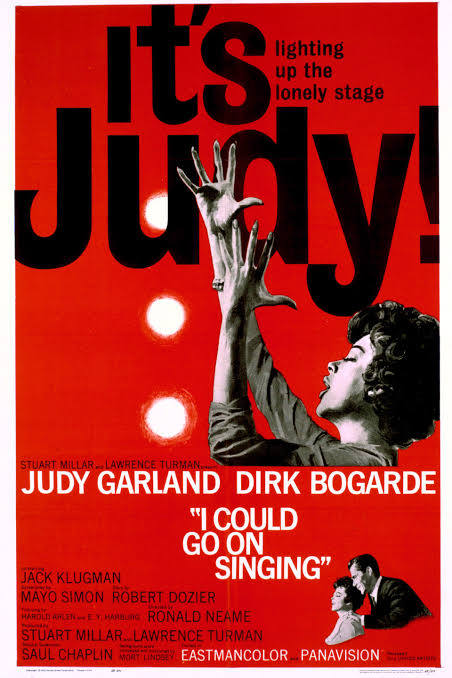
I Could Go On Singing is a 1963 British-American musical drama film directed by Ronald Neame. It stars Judy Garland in her final film performance, alongside Dirk Bogarde and Jack Klugman. Originally titled The Lonely Stage, the film was retitled to let audiences know that Garland sings in it; she had not sung in a film since A Star Is Born in 1954.
Although not a huge box-office success on release, the film won Garland much praise for her performance. This was Garland's final film before her death in 1969.
In his memoir, Bogarde claimed that he had substantially rewritten Garland's lines, with her consent.
Plot: Popular singer Jenny Bowman (Judy Garland) travels to London for a big show, and, while there, arranges a meeting with old flame David Donne (Dirk Bogarde), with whom — 15 years earlier — she produced a son named Matt (Gregory Phillips). Renewed sparks ignite between the erstwhile lovers while a fresh maternal bond is forged between Jenny and her estranged child. But when a bitter fight erupts between Jenny and David, Matt must decide which of his parents is more deserving of his loyalty.
Acting: Judy Garland played Jenny Bowman. I think I will always have mixed feelings about Judy. There's no question she's an amazing actress and singer, but her way of treating people was horrific. In fairness to her, she was a child star before the industry through they needed to protect young actors. Her four most notable titles include The Wizard of Oz, Meet Me in St. Louis, Judgment at Nuremberg, and A Star is Born. My favorite will probably always be The Wizard of Oz.
Dirk Bogarde played David Donne. The role/acting didn't stand out to me in any particular way. His four most notable titles The Servant, Darling, Death in Venice and A Bridge Too Far. I've only seen Our Mother's House, but I don't think I would watch it again.
Jack Klugman played George Kogan, Jenny Bowman's manager. I thought he was comical in this role. His most notable titles include 12 Angry Men, Days of Wine and Roses and the television shows Quincy, M.E., and The Odd Couple. My favorite is 12 Angry Men.
Gregory Phillips played Matt. He was impressive for a young actor. I'm sure it was a dream (and a nightmare) to be able to work with Judy Garland. His four most notable film/television titles are The Virgin Soldiers, I Could Go On Singing, Adolf Hitler: My Part in His Downfall and the Armchair Theatre television series. I haven't seen his other work.
Aline MacMahon played Ida, Miss Bowman's dresser. She did well in her minor role. Her four most notable titles include The World Changes, Kind Lady, Gold Diggers of 1933 and One Way Passage. I haven't seen her other work.
Technical Aspects: Officially regarded as her final film, she filmed it immediately after making A Child is Waiting (1963), though I Could Go on Singing was released first. At the time of filming, Garland was going through an ugly child custody battle of her own with her soon-to-be-divorced husband, Sid Luft. The opportunity to make a film in England with Dirk Bogarde, an actor and friend she had long admired, provided the perfect escape from her problems at home, but Garland unfortunately carried her troubles across the Atlantic.
"It Never Was You" is noteworthy for the fact that Judy Garland sand the entire song "live" on camera, rather than lip-syncing to a recorded track, as was the custom in movie musicals.
Judy Garland's children, Lorna Luft and Joey Luft, were extras in this movie.
Despite the inordinately exaggerated reports of Judy Garland's constant lateness and absence from shooting, this movie was completed on the set budget of 1.4 million dollars. Filming was completed in 12 weeks from May to July 1962.
From TCM: The story of a famous singer trying to gain custody of her illegitimate son from his surgeon father, I Could Go On Singing (1963) is a curious mixture of soap operas and autobiographical elements from Judy Garland's personal life.
At first, Garland seemed excited about making I Could Go On Singing (The working title was The Lonely Stage). Her character, Jenny Bowman, was an internationally renowned singer who was preparing for a performance at the London Palladium, one of her most popular concert venues in real life. But Garland didn't read the script until she was on location, and her reaction was no favorable. She told Bogarde, "I can't play this crap," and locked herself in the bathroom, a favorite retreat for her in times of emotional and physical distress. Luckily, Bogarde was able to convince his co-star that, together, they could improve the script with suggested changes that reflected their own verbal idiosyncrasies. The ploy worked for a while, and Garland was treated like royalty by director Ronald Neame and his cast and crew. Co-scripter Mayo Simon said, in Gerald Clarke's biography Get Happy, "The theory was that if we all just loved and admired her enough, everything would be okay. It turned out that there wasn't that much love in the world."
Only a few hours after her first day of shooting, Garland took an overdose of pills in a suicide attempt and was rushed to a hospital. For an explanation, she told Bogarde that she felt Neame hadn't shown her the proper respect that was due to a star of her caliber. Although she quickly recovered from this incident, Garland's mood swings and unstable emotional state would wreak havoc on the film's production schedule and crew. On good days, she would call Neame a "pussy cat." On bad days, she would refer to him as that "goddamned British Henry Hathaway" (a jab at an American director known for his bluster and swagger) and threaten to have him fired. She would also arrive on set, announcing sarcastically, "Here's Dorothy Adorable! Watch out!" and proceed to insult the crew. But her behavior grew worse —she began using the trash can in her room as a toilet — and led to more incidents of self-abuse and attempted suicide.
Yet, there were days during the filming of I Could Go On Singing when the camera captured the famous Garland magic. One memorable scene occurs when Bogarde visits Garland in the hospital, where she is nursing a sprained ankle and tried to convince her to return to the Palladium stage. Her impassioned response departed significantly from the script, becoming an improvised confessional full of candid, self-revelatory dialogue. In the Garland biography Get Happy, Gerald Clarke wrote, "A scene of such length — it lasts seven minutes... usually requires three or four days of work as well... But, as action progressed, Neame realized that what he was watching was a kind of magic. Instead of stopping the camera where he had planned — "I knew that I would never, ever get anything like that scene again."
Final Thoughts: This was a very interesting movie. Not only was it Judy Garland's last film, but the story also reflected parts of her life. The difference between her acting and singing in her early films and in this film is apparent. Between A Star is Born in 1954 and I Could Go On Singing in 1963, she appeared in four films but didn't sing in any of them. Her voice became more gravely and rough with age, along with her smoking and drinking. This movie was a sad but fitting ending to Judy Garland's film career. Just being able to see her as Jenny in contrast to her Dorothy Gale is worth the watch.
Where to watch it: According to Google, I Could Go On Singing is not currently available on any streaming service. You can purchase or rent a digital copy for a few dollars. I've also donated a DVD copy of the film to the Emil M. Larson Public Library in Clark for you all to enjoy, if you choose.