
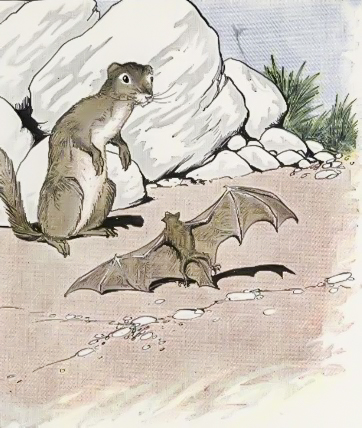
Introduction
Welcome to my corner! Last week, I shared with you the second and final part of "Riquet à la houppe" a French fairy tale. Also known as "Riquet with the Tuft" or "Ricky of the Tuft." Today, I'll be sharing with you three (yes, that's right, three!) of Aesop's Fables. The ones I'll be sharing are "The Bat and The Weasels," "The Ass and the Grasshopper" and "The Lion and The Mouse." I'm sharing three stories with you this week because of how short Aesop's Fables tend to be.
At the end of each, I'll share some of my thoughts. Enjoy!
The Bat And The Weasels
Aesop's Fables
A bat who fell upon the ground and was caught by a Weasel pleaded to be spared his life. The Weasel refused, saying that he was by nature the enemy of all birds. The Bat assured him that he was not a bird, but a mouse, and thus was set free. Shortly afterwards the Bat again fell to the ground and was caught by another Weasel, whom he likewise entreated not to eat him. The Weasel said that he had a special hostility to mice. The Bat assured him that he was not a mouse, but a bat, and thus a second time escaped.
It is wise to turn circumstances to good account.
In general, as kids we're taught that lying is bad and we shouldn't do it. However, as showcased by this fable, sometimes lying is the better option. In these circumstances, one might call them a fib or a white lie, otherwise known as a simple lie, unimportant lie or a harmless lie.
Teaching kids about lying can be very hard because of those muddy waters. How do you say to your child that lying is bad, and then go on lying to them about other things? I do think lying is bad, but sometimes it's unavoidable. I'm not sure there will ever by a simple way to teach that to children, but this fable could be a start.
The bat only lied so that he wouldn't be eaten. Can you really blame him?
The Ass And The Grasshopper
Aesop's Fables
An ass having heard some Grasshoppers chirping, was highly enchanted; and, desiring to possess the same charms of melody, demanded what sort of food they lived on to give them such beautiful voices. They replied, "The dew." The Ass resolved that he would live only upon dew, and in a short time died of hunger.
Dang nab! That got dark quickly! Short, sweet and to the point.
I had never heard of this fable, nor the one before it for that matter. I didn't know what to expect from the title. I find you can never guess what Aesop is going to throw at you, no matter which animals he chooses to write about.
I feel bad for the poor donkey. He just wanted the beautiful voice of the grasshoppers in the field. I'm not sure why he thought that what they ate had anything to do with their melodies, but that belief led him to his death, probably a horrible one at that.
He would have been better off just admiring their music, rather than trying to copy them to achieve the same thing. Let's face it, it's too easy to compare yourself to others; easier still to feel worse about yourself after the comparison. But I know that it's a heck of a lot easier to be yourself and love yourself for it. Some days are easier than others to do that, but in the end, you'll be happier that you were yourself and not a copy of someone else.
The Lion And The Mouse
Aesop's Fables
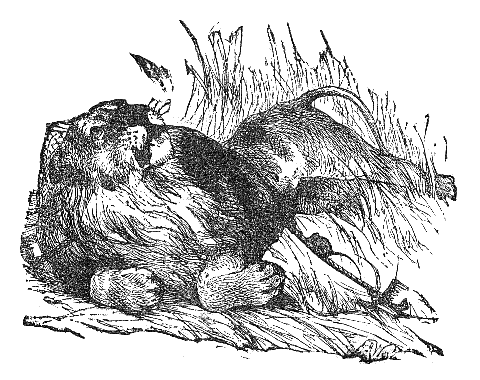
A Lion was awakened from sleep by a Mouse running over his face. Rising up angrily, he caught him and was about to kill him, when the Mouse piteously entreated, saying: "If you would only spared my life, I would be sure to repay your kindness." The Lion laughed and let him go. It happened shortly after this that the Lion was caught by some hunters, who bound him by strong ropes to the ground. The Mouse, recognizing his roar, came and gnawed the rope with his teeth, and set him free, exclaiming:
"You ridiculed the idea of my ever being able to help you, not expecting to receive from me any repayment of your favor; now you know that it is possible for even a Mouse to confer benefits on a Lion."
"The Lion and the Mouse" is easily one of my favorite Aesop's Fables. I think it's also one of the most well known as well.
The Mouse is caught by the Lion after he runs across his face, waking the Lion. Not very smart of the Mouse to do if he's looking to keep his life. But surprisingly, the Mouse is able to convince the Lion to let him go because he promises to repay the kindness later. The Lion, being much bigger and stronger than the Mouse, scoffs at the idea that a tiny Mouse, scoffs at the idea that a tiny Mouse could be of any help to him.
However, he lets the Mouse go anyway. I guess it was just so funny to the Lion that he had pity on the Mouse. I still find it puzzling though. I guess a Mouse wouldn't be much a meal for a Lion, anyway.
Later, the Lion finds himself caught in a hunter's trap/rope. Despite being big and strong, he is now helpless. The Mouse comes to the rescue, looking to repay the kindness he was shown. Although, the Lion's kindness was more of a joke than true kindness, the Mouse kept his word.
The Mouse used his teeth to cut the ropes and free the Lion from the hunters. Then he basically tells the Lion: "See, I told ya!" You tell 'em Mousey!
"Don't judge a book by its cover" and "a kindness is never wasted" are the morals of this fable. Despite being very different from the Lion, the Mouse was able to help the Lion and exceed his expectations. Help, or kindness, can come from anyone, anywhere at anytime. You should never turn it away. Why would you?
At the same time, it's not hard to be kind. It might not be second nature to everyone, but it's certainly not hard. Being kind is the easiest thing you can do for someone. You never know what someone is going through, so just be kind. It's that simple.
That's it for this week! What were your thoughts? Feel free to share them with us! You can call us, email us, visit us at the office, leave us a comment or message on Facebook, or even mail us something. Keep the comments, suggestions, questions, submissions, etc. coming our way! We'd love to hear from you!