
Introduction
Welcome to my corner! Last week, I shared with you the first part of "The Tell-Tale Heart" by Edgar Allan Poe. This week, I'll be sharing the second (also the last) part. At the end, I'll share more of my thoughts.
The Tell-Tale Heart
Edgar Allan Poe
But even yet I refrained and kept still. I scarcely breathed. I held the lantern motionless. I tried how steadily I could maintain the ray upon the eye. Meantime the hellish tattoo of the heart increased. It grew quicker and quicker, and louder and louder every instant. The old man's terror must have been extreme! It grew louder, I say, louder every moment! —do you mark me well? I have told you that I am nervous: so I am. And now at the dead hour of the night, amid the dreadful silence of that old house, so strange a noise as this excited me to uncontrollable terror. Yet, for some minutes longer I refrained and stood still. But the beating grew louder, louder! I thought the heart must burst. And now a new anxiety seized me—the sound would be heard by a neighbor! The old man's hour had come! With a loud yell, I threw open the lantern and leaped into the room. He shrieked once—once only. In an instant I dragged him to the floor, and pulled the heavy bed over him. I then smiled gaily, to find the deed so far done. But, for many minutes, the heart beat on with a muffled sound. This, however, did not vex me; it would not be heard through the wall. At length it ceased. the old man was dead. I removed the bed and examined the corpse. Yes, he was stone, stone dead. I placed my hand upon the heart and held it there many minutes. There was no pulsation. He was stone dead. His eye would trouble me no more.
If still you think me mad, you will think so no longer when I describe the wise precautions I took for the concealment of the body. The night waned, and I worked hastily, but in silence. First of all I dismembered the corpse. I cut off the head and the arms and the legs.
I then took up three planks from the flooring of the chamber, and deposited all between the scantlings. I then replaced the boards so cleverly, so cunningly, that no human eye—not even his—could have detected any thing wrong. There was nothing to wash out—no stain of any kind—no blood-spot whatever. I had been too wary for that. A tub had caught all—ha! ha!
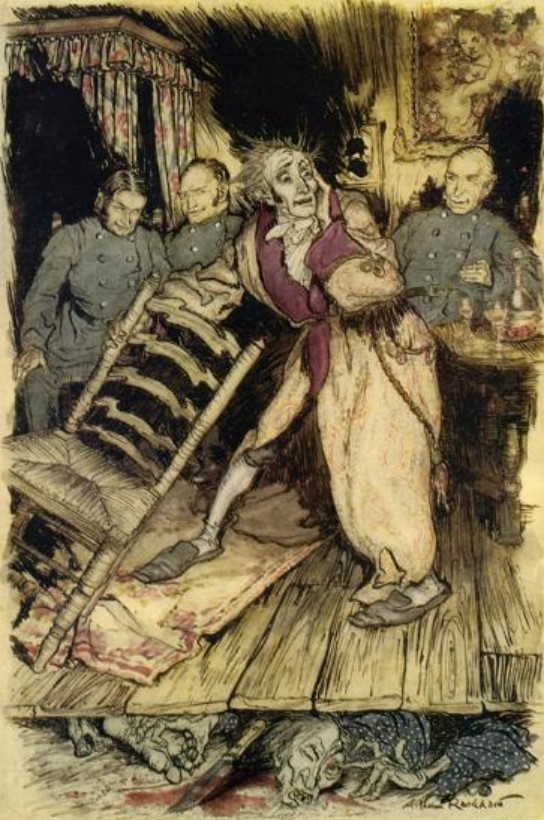
When I had made an end of these labors, it was four o'clock—still dark as midnight. As the bell sounded the hour, there came a knocking at the street door. I went down to open it with a light heart, —for what had I now to fear? There entered three men, who introduced themselves, with perfect suavity, as officers of the police. A shriek had been heard by a neighbor during the night; suspicion of foul play had been aroused; information had been lodged at the police office, and they (the officers) had been deputed to search the premises.
I smiled, —for what had I to fear? I bade the gentlemen welcome. The shriek, I said, was my own in a dream. The old man, I mentioned, was absent in the country. I took my visitors all over the house. I bade them search—search well. I led them, at length, to his chamber. I showed them his treasures, secure, undisturbed. In the enthusiasm of my confidence, I brought chairs into the room, and desired them here to rest from their fatigues, while I myself, in the wild audacity of my perfect triumph, placed my own seat upon the very spot beneath which reposed the corpse of the victim.
The officers were satisfied. My manner had convinced them. I was singularly at ease. They sat, and while I answered cheerily, they chatted of familiar things. But, ere long, I felt myself getting pale and wished them gone. My head ached, and I fancied a ringing my ears: but still they sat and still chatted. The ringing became more distinct: —it continued and became more distinct: I talked more freely to get rid of the feeling: but it continued and gained definitiveness—until, at length, I found that the noise was not within my ears.
No doubt I now grew very pale; —but I talked more fluently, and with a heightened voice. Yet the sound increased—and what could I do? It was a low, dull, quick sound—much such a sound as a watch makes when enveloped in cotton. I gasped for breath—and yet the officers heard it not. I talked more quickly—more vehemently; but the noise steadily increased. I arose and argued about trifles, in a high key and with violent gesticulations; but the noise steadily increased. Why would they not be gone? I paced the floor to and fro with heavy strides, as if excited to fury by the observations of the men—but the noise steadily increased. Oh God! what could I do? I foamed—I raved—I swore! I swung the chair upon which I had been siting, and grated it upon the boards, but the noise arose over all and continually increased. It grew louder—louder—louder! And still the men chatted pleasantly, and smiled. Was it possible they heard not? Almighty God! —no, no! They heard! —they suspected! —they knew! —they were making a mockery of my horror! —this I thought, and this I think. But anything was better than this agony! Anything was more tolerable than this derision! I could bear those hypocritical smiles no longer! I felt that I must scream or die! —and now—and again! —hark! louder! louder! louder! louder!—
"Villains!" I shrieked, "dissemble no more! I admit the deed! —tear up the planks! —here, here! —it is the beating of his hideous heart!"
Last week in my review, I was pondering why this story in particular, out of all of Edgar Allan Poe's work, stuck with me. I've concluded, only recently, that this tale strikes me because I can relate to the fear and anxiety that the main character feels.
Mine and the character's fear and anxiety are not quite the same, as his focuses more on murdering someone and the aftermath of that, and I haven't killed anyone! My fear and anxiety is triggered when I'm around people; it's worse if they're strangers. I can keep it under control with small groups of people, but large crowds make me uncomfortable and nearly send me into a panic.
People who know me might describe me as shy and quiet. I've heard both of those terms a lot in my life. I think I can blame my fear and anxiety for that. I never felt brave enough to speak up, and even when I did, it seemed like no one heard me.
When I feel fear or anxiety, my heart starts to race, my breath quickens, my palms sweat, my eyes dart around the room, my hands twitch, and my feet tap the ground. As you might imagine, being out in public in this state is not very fun for me, which is why I generally don't go out unless I have to. It's the worst if I'm by myself, but I'm better with a companion or two.
"The Tell-Tale Heart" creates this fear and anxiety within the main character. the readers are also supposed to get this sense of fear and anxiety while reading. That was accomplished with me.
The main character "treats" his fear and anxiety by killing the man with the evil eye that torments him. This eases his feelings, but only momentarily. The evil eye was replaced by the relentless beating heart of the dead man he killed. He's tormented once again, worse now, partially because he feels guilty.
It just goes to show that there's never an easy way out. And most certainly, killing will never be the correct answer.