
Introduction
Welcome to my corner! Last week, I shared with you the first part of "Riquet à la houppe" a French fairy tale. It's also known as "Riquet with the Tuft." Today, I'll share with you the second (and final) part of the tale. At the end, I'll share some of my thoughts.
Riquet with the Tuft
Charles Perrault
The princess had so little sense, and at the same time desired it so ardently, that she persuaded herself the end of this year would never come. So she accepted the offer which had been made to her. No sooner had she given her word to Ricky that she would marry him within one year from that very day, than she felt a complete change come over her. She found herself able to say all that she wished with the greatest ease, and to say it in an elegant, finished, and natural manner. She at once engaged Ricky in a brilliant and lengthy conversation, holding her own so well that Ricky feared he had given her a larger share of sense than he had retained for himself.
On her return to the palace amazement reigned throughout the court at such a sudden and extraordinary change. Whereas formerly they had been accustomed to hear her give vent to silly, pert remarks, they now heard her express herself sensibly and very wittily.
The entire court was overjoyed. The only person not too pleased was the younger sister, for now that she had no longer the advantage over the elder in wit, she seemed nothing but a little fright in comparison.
The king himself often took her advice, and several times held his councils in her apartment.
The news of this change spread abroad, and the princes of the neighboring kingdoms made many attempts to captivate her. Almost all asked her in marriage. But she found none with enough sense, and so she listened to all without promising herself to any.
At last came one who was so powerful, so rick, so witty, and so handsome, that she could not help being somewhat attracted by him. Her father noticed this, and told her she could make her own choice of a husband. She had only to declare herself. Now the more sense one has, the more difficult it is to make up one's mind in an affair of this kind. After thanking her father, therefore, she asked for a little time to think it over. In order to ponder quietly what she had better do she went to walk in a wood—the very one, as it happened, where she had encountered Ricky of the Tuft.
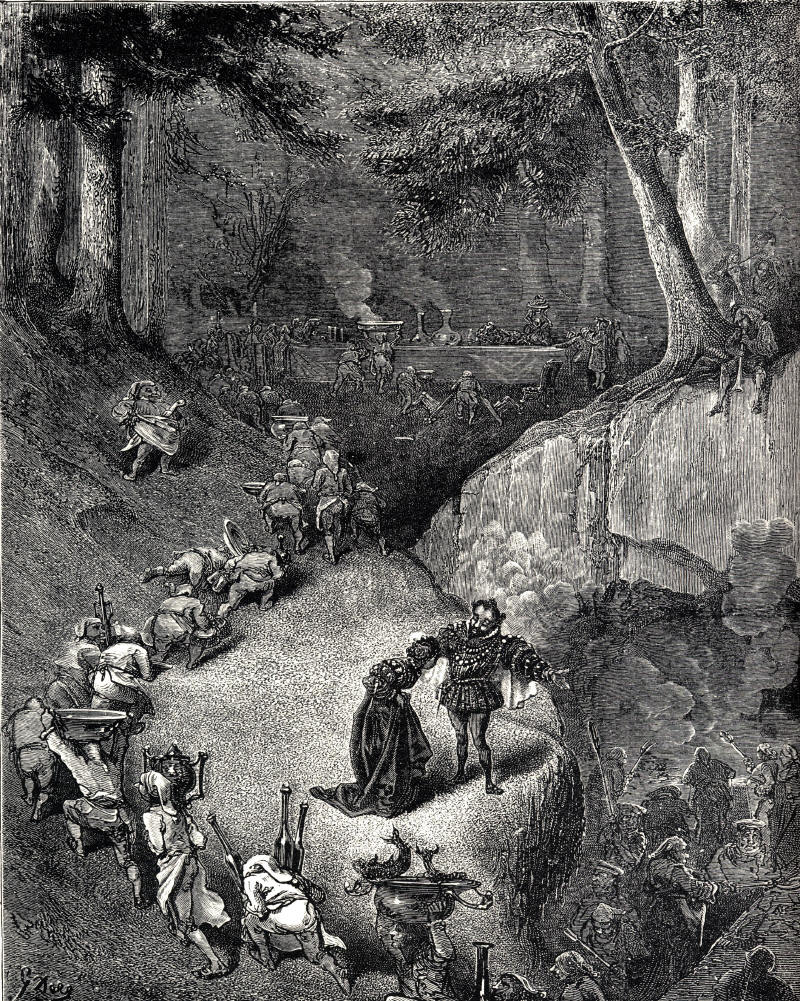
While she walked, deep in thought, she heard beneath her feet a thudding sound, as though many people were running busily to and fro. Listening more attentively she hear voices. "Bring me that boiler," said one; then another, "Put some wood on that fire!"
At that moment the ground opened, and she saw below what appeared to be a large kitchen full of cooks and scullions, and all the train of attendants which the preparation of a great banquet involves. A gang of some twenty or thirty spit-turners emerged and took up their positions round a very long table in a path in the wood. They all wore their cook's caps on one side, and with their basting implements in their hands they kept time together as they worked, to the lilt of a melodious song.
The princess was astonished by this spectacle, and asked for whom their work was being done.
"For Prince Rick of the Tuft, madam," said the foreman of the gang. "His wedding is tomorrow."
At this the princess was more surprised than ever. In a flash she remembered that it was a year to the very day since she had promised to marry Prince Ricky of the Tuft, and was taken aback by the recollection. The reason she had forgotten was that when she made the promise she was still without sense, and with the acquisition of that intelligence which the prince had bestowed upon her, all memory of her former stupidities had been blotted out.
She had not gone another thirty paces when Ricky of the Tuft appeared before her, gallant and resplendent, like a prince upon his wedding day.
"As you see, madam," he said, "I keep my word to the minute. I do not doubt that you have come to keep yours, and by giving me your hand to make me the happiest of men."
"I will be frank with you," replied the princess. "I have not yet made up my mind on the point, and I am afraid I shall never be able to take the decision you desire."
"You astonish me, madam," said Ricky of the Tuft.
"I can well believe it," said the princess, "and undoubtedly, if I had to deal with a clown, or a man who lacked good sense, I should feel myself very awkwardly situated. 'A princess must keep her word,' he would say, 'and you must marry me because you promised promised to!' But I am speaking to a man of the world, of the greatest good sense, and I am sure that he will listen to reason. As you are aware, I could not make up to my mind to marry you even when I was entirely without sense; how can you expect that today, possessing the intelligence you bestowed on me, which makes me still more difficult to please than formerly, I should take a decision which I could not take then? If you wished so much to marry me, you were very wrong to relived me of my stupidity, and to let me see more clearly than I did."
"If a man who lacked good sense," replied Ricky of the Tuft, "would be justified, as you have just said, in reproaching you for breaking your word, why do you expect, madam, that I should act differently where the happiness of my whole life is at stake? Is it reasonable that people who have sense should be treated worse than those who have none? Would you maintain that for a moment—you, who so markedly have sense, and desired so ardently to have it? But, pardon me, let us get to the facts. With the exception of my ugliness, is there anything about me which displeases you? Are you dissatisfied with my breeding, my brains, my disposition, or my manners?"
"In no way," replied the princess. "I like exceedingly all that you have displayed of the qualities you mention."
"In that case," said Ricky of the Tift, "happiness will be mine, for it lies in your power to make me the most attractive of men."
"How can that be done?" asked the princess.
"It will happen of itself," replied Ricky of the Tuft, "if you love me well enough to wish that it be so. To remove your doubts, madam, let me tell you that the same fairy who on the day of my birth bestowed upon me the power of endowing with intelligence the woman of my choice, gave to you also the power of endowing with beauty the man whom you should love, and on whom you should wish to confer this favor."
"If that is so," said the princess, "I wish with all my heart that you may become the handsomest and most attractive prince in the world, and I give you without reserve the boon which it is mine to bestow."
No sooner had the princess uttered these words than Ricky the Tuft appeared before her eyes as the handsomest, most graceful and attractive man that she had ever set eyes on.
Some people assert that this was not the work of fairy enchantment, but that love alone brought about the transformation. They say that the princess, as she mused upon her lover's constancy, upon his good sense, and his many admirable qualities of heart and head, grew blind to the deformity of his body and the ugliness of his face; that his humpback seemed no more than was natural in a man who could make the courtliest of bows, and that the dreadful limp which had formerly distressed her now betokened nothing more than a certain diffidence and charming deference of manner. They say further that she found his eyes shine all the brighter for their squint, and that this defect in them was to her but a sign of passionate love; while his great red nose she found naught but martial and heroic.
However that may be, the princess promised to marry him on the spot, provided to marry him on the spot, provided only that he could obtain the consent of her royal father.
The king knew Ricky of the Tuft to be a prince of both wise and witty, and on learning of his daughter's regard for him, he accepted him with pleasure as a son-in-law.
The wedding took place upon the morrow, just as Ricky of the Tuft had foreseen, and in accordance with the arrangements he had long ago put in train.
On the surface, this tale seems to be about love and looking past appearances. It tries to convince readers of that near the end where it states Ricky's flaws perhaps only seemed to go away because of love, and not magic. However, I'm not so convinced anymore.
First of all, Ricky and the eldest princess don't even really know each other. Ricky only approached her to request marriage after falling in love with her portrait. It's much the same for the eldest princess. She doesn't want to marry Ricky until he assures her that she has the power to make him the most handsome and attractive prince in the world.
Despite Perrault's attempt to rewrite this tale with the moral of "beauty is only skin deep," he missed the mark for me. I'm not going to lie, I'm a little disappointed about it. I had high hopes for this tale. I also can't help but feel bad for the younger, uglier princess. Despite being ugly, people treated her well because of her good sense, but after the eldest princess became smarter, she was left alone again.
I haven't rad the full version of Bernard's tale, but I read a summary of it, and I can still confidently say that Perrault's is the easier read.
What were your thoughts? Feel free to share them with us! You can call us, email us, visit us at the office, leave us a comment or message on Facebook, or even mail us something. Keep the comments, suggestions, questions, submissions, etc. coming our way! We'd love to hear from you!