
Introduction
Welcome to my corner! Last week, I shared with you "The Wolf and the Seven Little Kids" one of Grimm's Fairy Tales. Today, I'll be sharing with you "The Princess and the Pea" by Hans Christian Andersen.
At the end, I'll share some of my thoughts. Enjoy!
The Princess and the Pea
Hans Christian Andersen
One upon a time, there was a prince who wanted to marry a princess; but she would have to be a real princess. He travelled all over the world to find one, but nowhere could he get what he wanted. There were princesses enough, but it was difficult to find out whether they were real ones. There was always something about them that was not as it should be. So he came home again and was sad, for he would have liked very much to have a real princess.
One evening a terrible storm came on; there was thunder and lightning, and the rain poured down in torrents. Suddenly, a knocking was heard at the city gate, and the old king went to open it.
It was a princess standing out there in front of the gate. But, good gracious! What a sight the rain and the wind had made her look. The water ran down from her hair and clothes; it ran down into the toes of her shoes and out again at the heels. And yet she said that she was a real princess.
Well, we'll soon find that out, thought the old queen. But she said nothing, went into the bed-room, took all the bedding off the bedstead, and laid a pea on the bottom; then she took twenty mattresses and laid them on the pea, and then twenty eider-down beds on top of the mattresses.
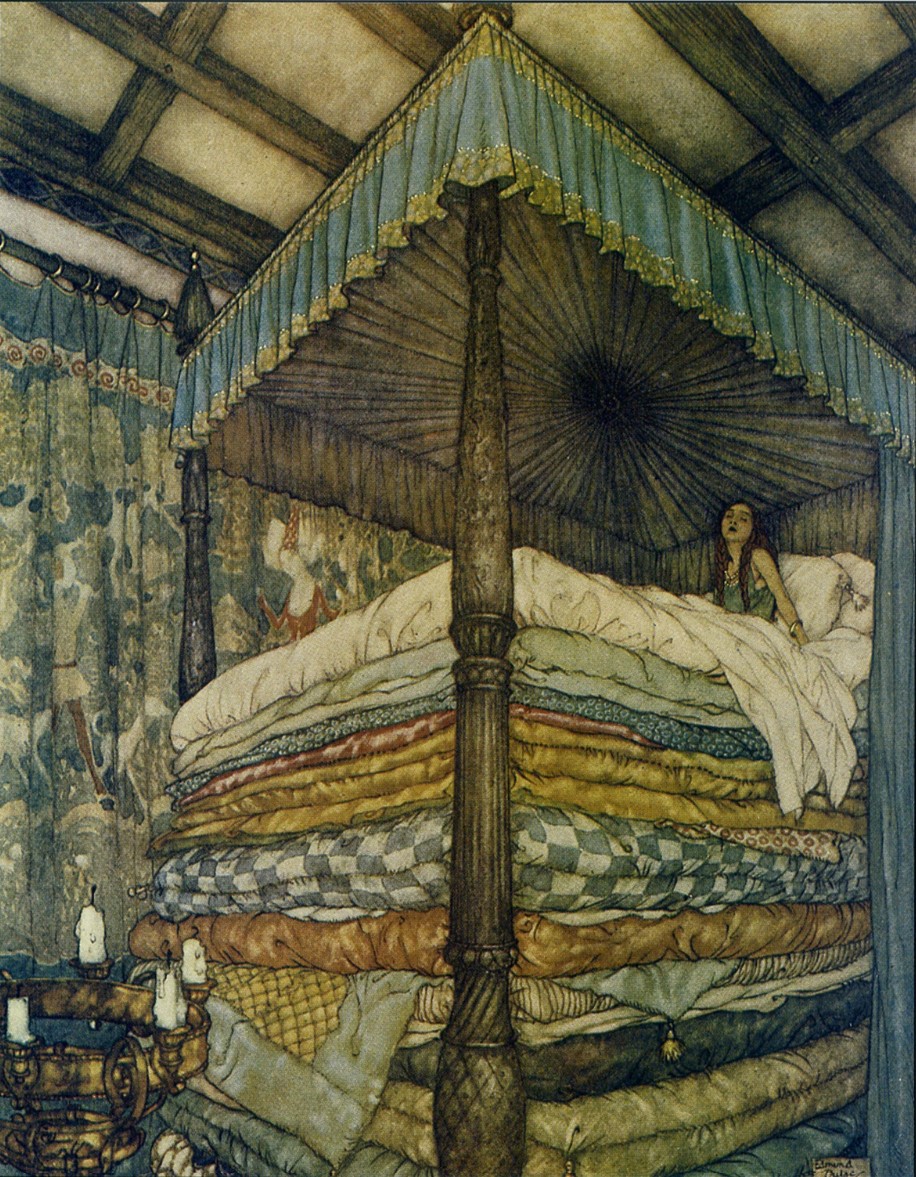
On this the princess had to lie all night. In the morning she was asked how she had slept.
Oh, very badly! said she. I have scarcely closed my eyes all night. Heaven only knows what was in the bed, but I was lying on something had, so that I am black and blue all over my body. It's horrible!
Now they knew that she was a real princess because she had felt the pea right through the twenty mattresses and the twenty eider-down beds.
Nobody but a real princess could be as sensitive as that.
So the prince took her for his wife, for now he knew that he had a real princess; and the pea was put in the museum, where it may still be seen, if no one has stolen it.
There, that was a true story.
What a peculiar story.
This tale originated in the Denmark, meaning that it was written in the Danish language and later translated. In that sense, some of the meaning was lost on me in translation because in the story where they use the world "real", it actually means "rightful" in Danish. That makes a little more sense to me. The two terms are pretty similar but calling them "real" princesses just seemed weird.
I'm pretty sure this is another fairly well known tale, one of Hans Christian Andersen's at that. I'll be honest though; I don't remember the story being told in quite this way, so I'm thinking I'm more familiar with a more modern adaption. Or, maybe I just have a horrible memory.
In the story that I thought I recalled, the queen was the one trying to find the prince a wife and had failed many times to find a suitable one. The prince was barely even mentioned, or present, in the story I'm remembering. If this was an actual adaptation of the story, or I'm just making it up, we'll probably never know.
Either way, I'm curious to know why the fact that she could feel a pea through 20 mattresses and 20 eider-down beds mean that she was a true princess. They even comment on it by saying, "Nobody but a real princess could be as sensitive as that." Now, I'm not sure how to take that. I feel like it's a commentary on obviously the princess, but also women as a whole.
Maybe I'm reading a little too much into this one sentence, but it's the only thing I have to work off of to answer my previous query. My take on it is that if a woman (princess) is not sensitive enough, the she is not a real woman (princess).
According to Google, sensitive, can be defined as "quick to detect or respond to slight changes, signals, or influences" or "(or a person or person's behavior) having or displaying a quick and delicate appreciation of others' feelings." The Cambridge Dictionary provides a slightly more detailed definition to describe a person, "easily upset by the things people say or do, or causing people to be upset, embarrassed or angry." The latter definition was what came to my mind.
Circling back to my take on the sentence in the tale. I feel it's referring to one's, particularly a woman's, femininity. Sensitivity is one of the stereotypical feminine traits a woman is thought to have. Others include nurturance, sweetness, supportiveness, gentleness, warmth, passivity, cooperativeness, expressiveness, modesty, humility, empathy, affection, tenderness and being emotional, kind, helpful and devoted.
After thinking about it in this light, I feel that the other princesses weren't feminine enough for the prince of the queen. To back up my theory, I actually watched a read aloud picture book video on YouTube about "The Princess and the Pea" where some of the "fake" princesses were illustrated with the prince. The video can be found at this link: here.
The first "fake" princess was pictured chasing after some chickens. The second one was a messy eater. The third one kept wolves as pets. And, the fourth and final "fake" princess appeared to be a bad singer. How do any of these disqualify them from being "real" princesses? They must have been too unladylike for the prince and the queen to be viewed as the princesses they truly were.
It's a shame that women were viewed this way then, and in many cases still are today. People are more than their appearances and behaviors. Give them a chance.
That's it for this week! What were your thoughts? Feel free to share them with us! You can call us, email us, visit us at the office, leave us a comment or message on Facebook, or even mail us something. Keep the comments, suggestions, questions, submissions, etc. coming our way! We'd love to hear from you!