
Introduction
Welcome to my corner! Last week, I shared with you the first part of "The Raven" by Edgar Allan Poe. This week, we'll be finishing "The Raven" with this second part. More of my thoughts will follow at the end.
Enjoy!
The Raven (part 2)
Edgar Allan Poe
Startled at the stillness broken by reply so aptly spoken,
"Doubtless," said I, "what it utters is its only stock and store
Caught from some unhappy master whom unmerciful Disaster
Followed fast and followed faster till his songs one burden bore--
Till the dirges of his Hope that melancholy burden bore
Of 'Never--nevermore.
But the Raven still beguiling all my fancy into smiling,
Straight I wheeled a cushioned seat in front of bird, and bust and door;
Then, upon the velvet sinking, I betook myself to linking
Fancy unto fancy, thinking what this ominous bird of yore--
What this grim, ungainly, ghastly, gaunt, and ominous bird of yore
Meant in croaking "Nevermore"
This I sat engaged in guessing, but no syllable expressing
To the fowl whose fiery eyes now burned into my bosom's core;
This and more I sat divining, with my head at ease reclining
On the cushion's velvet lining that the lamp-light gloated o'er,
But whose velvet-violet lining with the lamp-light gloating o'er,
She shall press, ah, nevermore!
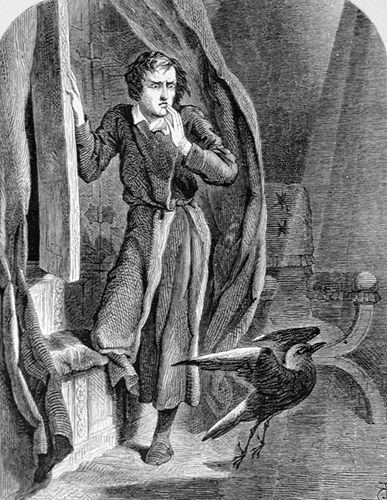
Then, methought, the air grew denser, perfumed from an unseen censer
Swung by Seraphim whose footfalls tinkled on the tufted floor.
"Wretch," I cried, "thy God hath lent thee--by these angels he hath sent thee
Respite--Respite and nepenthe from thy memories of Lenore;
Quaff, oh quaff this kind nepenthe and forget this lost Lenore!"
Quoth the Raven "Nevermore."
"Prophet!" said I, "thing of evil!--prophet still, if bird or devil--
Whether Tempter sent, or whether tempest tossed thee here ashore,
Desolate yet all undaunted, on this desert land enchanted--
On this home by Horror haunted--tell me truly, I implore--
Is there--is there balm in Gilead?--tell me--tell me, I implore!
Quoth the Raven "Nevermore."
"Prophet!" said I, "thing of evil!--prophet still, if bird or devil!
By that Heaven that bends above us--by that God we both adore--
Tell this soul with sorrow leaden if, within the distant Aidenn,
It shall clasp a sainted maiden whom the angels name Lenore--
Clasp a rare and radiant maiden whom the angels name Lenore."
Quote the Raven "Nevermore."
"Be that word our sign of parting, bird or fiend!" I shrieked, upstarting--
"Get thee back into the tempest and the Night's Plutonian shore!
Leave no black plume as a token of that lie thy soul hath spoken!
Leave my loneliness unbroken!--quit the bust above my door!
Take thy break from out my heart, and take thy form from off my door!"
Quoth the Raven "Nevermore."
And the Raven, never flitting, still is sitting, still is sitting
On the pallid bust of Pallas just above my chamber door;
And his eyes have all the seeming of a demon's that is dreaming,
And the lamp-light o'er him streaming throws his shadow on the floor;
And my soul from out that shadow that lies floating on the floor
Shall be lifted--nevermore!
Last week, I left off talking about Edgar Allan Poe and Vincent Price, and how much I love them both. It's hard for me to not go on and one about Vincent Price, but I will try my best to stick to my thoughts on the poem this week.
This poem is considerably longer than I remember it being, but I usually listen to it, rather than reading it myself. Regardless of its length, the poem is fast paced due to Poe's skillful hand. As I said in last week's column, I'm not a big fan of poetry in general, so I'm not overly familiar with poetry terminology. The rhythm of the poem helps to speed up the pace.
Anyone familiar with Poe's work knows that they tend to be dark and macabre, also often scary. "The Raven" is slightly different in that sense because the "scary" imagery is reserved to the namesake raven. There aren't any descriptions of corpses, organs, bodily fluids, etc. Also, the object of this poem isn't necessarily to scare the reader either, although you might get scared either way. Rather, the poem explores the sadness a man goes through after losing his beloved wife, Lenore.
The Raven symbolizes the man's emotional state. No matter what he does, the Raven continues to cry out, "Nevermore." At first, the man seemed excited to have a potential visitor, but as the Raven repeated "Nevermore" over and over, the bird and the phrase grew more terrifying to him. He didn't want to be alone, He didn't want to be without Lenore.
It's never mentioned in the poem how Lenore met her end, but I assume it was something unavoidable, or out of their control. If it had been a horrible accident or murder or the like, I feel Poe would've mentioned it, making the poem more in-line with his other work. Not that it matter a whole lot, but the character's emotional state could be different depending on how Lenore died.
Not being able to do anything to prevent a loved one's death may cause a person great sadness, whereas being the cause of her death might cause more guilt, like "The Tell-Tale Heart."
Loss is almost always accompanied by sadness. Everyone at some point in their life will experience loss and sadness. It's an unfortunate part of life.
That's it for this week! What were your thoughts? Feel free to share them with us! You can call us, email us, visit us at the office, leave us a comment or message on Facebook, or even mail us something. Keep the comments, suggestions, questions, submissions, etc. coming our way! We'd love to hear from you!