
Introduction
Welcome to my corner! This week, I'm sharing my thoughts on the film 12 Angry Men. If this movie isn't on a list of movies you have to watch before you die, it certainly should be! Enjoy!
12 Angry Men
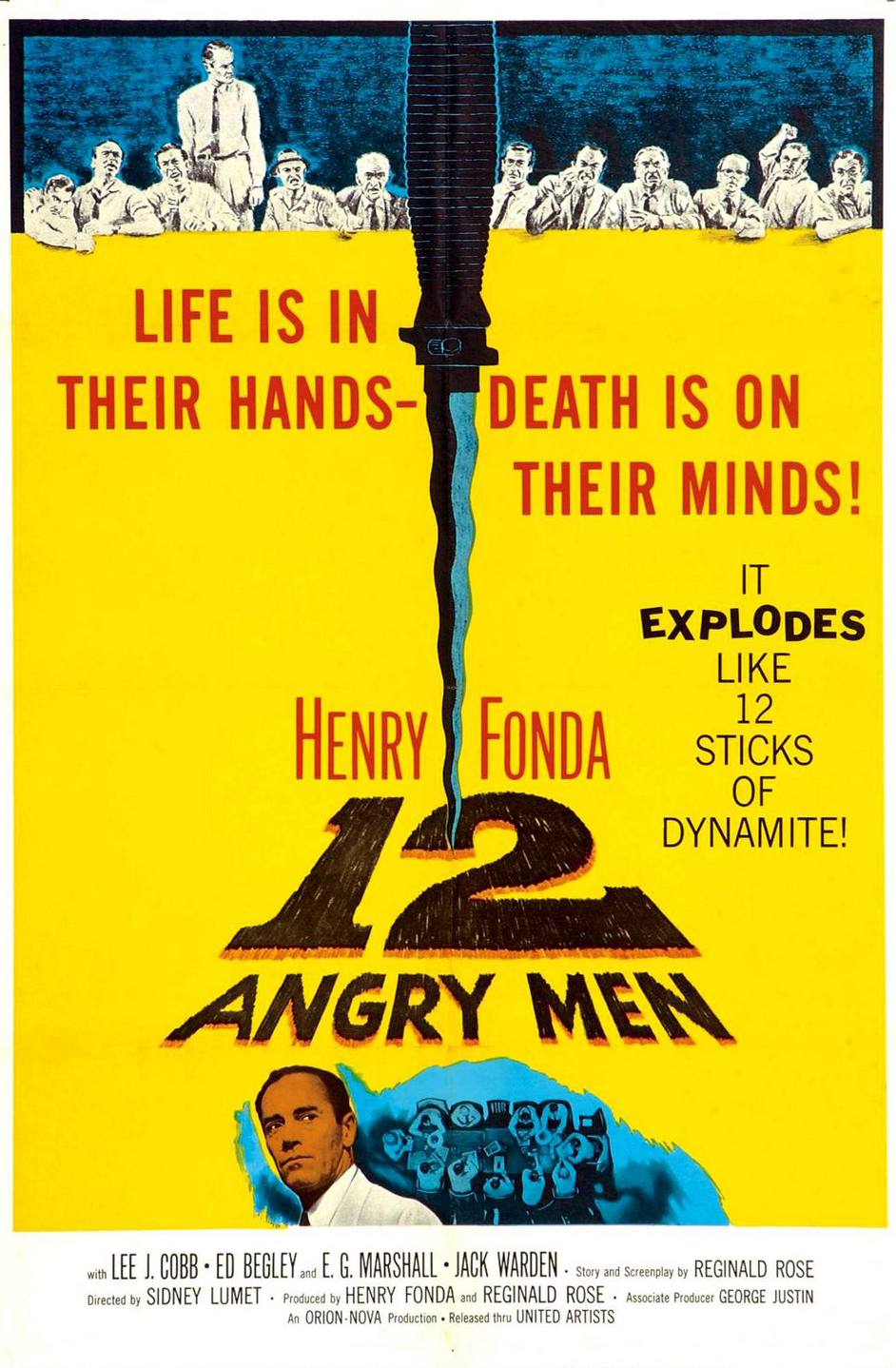
12 Angry Men is a 1957 American legal drama film directed by Sidney Lumet in his feature directorial debut, adapted by Reginald Rose from his 1954 teleplay. A critique of the American jury system during the McCarthy era, the film tells the story of a jury of 12 men as they deliberate the conviction or acquittal of a teenager charged with murder on the basis of reasonable doubt; disagreement and conflict among the jurors forces them to question their morals and values. It stars an ensemble cast, featuring Henry Fonda (who also produced the film with Rose), Lee J. Cobb, Ed Begley, E. G. Marshall, and Jack Warden.
An independent production distributed by United Artists, 12 Angry Men received acclaim from critics, despite a lukewarm box-office performance. At the 30th Academy Awards, it was nominated for Best Picture, Best Director and Best Screenplay. It is regarded by many as one of the greatest films ever made.
In 2007, it was selected for preservation in the United States National Film Registry by the Library of Congress as being "culturally, historically, or aesthetically significant." Additionally, it was selected as the second-best courtroom drama ever (after 1962's To Kill a Mockingbird) by the American Film Institute for their AFI's 10 Top 10 list.
Plot: The jury in a New York City murder trial is frustrated by a single member whose skeptical caution forces them to more carefully consider the evidence before jumping to a hasty verdict.
Acting: My favorite title is 12 Angry Men for the following actors. Because there's so many actors, I won't be able to list their most notable credits and my favorite film(s) of those credits.
Juror #1, the foreman; a calm and methodical assistant high school football coach, was played by Martin Balsam.
Juror #2, a meek and unpretentious bank teller who is easily flustered, but eventually stands up for himself, was played by Joh Fiedler.
Juror #3, a loud, hot-tempered owner of a messenger service who is estranged from his son; the most passionate advocate of a "guilty" verdict, was played by Lee J. Cobb.
Juror #4, an unflappable, conscientious, and analytical stockbroker who is concerned only with facts, not opinions, was played by E. G. Marshall.
Juror #5, a Baltimore Orioles fan who grew up in a violent slum, and is sensitive to bigotry towards "slum kids," was played by Jack Klugman.
Juror #6, a tough but principled and courteous painter who stands up to others, especially over the elderly being verbally abused, was played by Edward Binns.
Juror #7, an impatient and wisecracking salesman who is more concerned about the Yankees game he is missing than the case, was played by Jack Warden.
Juror #8, a humane, justice-seeking architect and father of three; initially, the only one to question the evidence and vote "not guilty." The closing scene reveals his surname is 'Davis,' was played by Henry Fonda.
Juror #9, a thoughtful and intelligent elderly man who is highly observant of the witnesses' behaviors and thier possible motivations. The closing scene reveals his surname is 'McCardle,' was played by Joseph Sweeney.
Juror #10, a pushy, loud-mouthed and xenophobic garage owner, was played by Ed Begley.
Juror #11, a polite European watchmaker and naturalized American citizen who demonstrates strong respect for democratic values such as due process, was played by George Voskovec.
Juror #12, an indecisive and easily distracted advertising executive, was played by Robert Weber.
Minor roles were played by Rudy Bond as the judge; Tom Gorman as the court stenographer; James Kelly as the bailiff; Billy Nelson as the clerk; and John Savoca as the defendant.
Background information: 12 Angry Men was shot entirely in New York City and the opening and closing exteriors depict Foley Square. According to a Hollywood Reporter (HR) article dated Apr 1957, the film was rehearsed and shot in a little over a month, at a cost of $340,000.
12 Angry Men marked the directing debut of Sidney Lumet (1924-2011). According to a biography of Fonda, Fonda hired Lumet because he had extensive experience in television and had a reputation for staying on schedule and within a budget. Both Fonda and Rose deferred their salaries for the film. Daily Variety (DV) reported that although a year and a half after the film's release the two producers had yet to receive even half of their fees, they had been successful in selling European theatrical rights to producer Lars Schmidt.
Although the film received rave reviews and was nominated for three Academy Awards (Best Picture, Best Director and Best Adapted Screenplay), it did only modest in business, grossing a total of $1,000,000, according to a Variety news item dated March 1958. 12 Angry Men won the Writer's Guild of America Award for Best Film and was also exceptionally popular with foreign critics. It won top awards from the British Film Academy, as well as from the Italian and Polish Film Critics Associations and the Berlin Film Festival.
As noted in an Aug. 1956 (HR) news item, the State Bar Association were given preview showings of the picture prior to its press previews. Subsequent to the film's release, the American Bar Association honored the film for "contributing to greater public understanding and appreciation of the American system of justice."
A (HR) news item, dated May 1966, noted that 12 Angry Men had long been used as an industrial training aid for corporate managers studying the interaction, emotions and prejudices of group decision making. According to his autobiography, Fonda was disappointed with United Artists' distribution strategy and felt that the studio's approach had deprived the film of a chance at financial success. In particular, Fonda noted that United Artists placed 12 Angry Men in theaters too large for a "small" film to fill and, in addition, did not re-release it after it won numerous awards.
Final Thoughts: I love legal dramas. I am very intrigued by the legal system, in or out of the courtroom. 12 Angry Men is the movie that sparked my interest in legal drama movies. The first time I saw 12 Angry Men was in government class in high school. Ever since, I've been eager to be a juror, unlike the rest of the population. I was so excited when I got to be a juror during my time at Girls State.
Whether or not it's on an "official" list, you should definitely watch 12 Angry Men before you die. Even if you don't generally like legal dramas, 12 Angry Men is a great commentary on social issues and relationships. It's also entirely possible that you have seen an episode or two of television shows that play homage to 12 Angry Men and the juror system. Just to name a few: The Odd Couple, Happy Days, Murder, She Wrote, Hey Arnold!, The DEad Zone, Veronica Mars, The Equalizer, Family, King of the Hill, Matlock, The Simpsons, Charmed, Mork & Mindy, Yellowjackets, Sesame Street, Pepper Ann, Robot Chicken, Tom & Jerry, The Dick Van Dyke Show, That Girl, Here's Lucy, and many more.
Side notes: A mandatory death sentence if found guilty? How many people died because of a mandatory death sentence when they were actually innocent? That is exactly why we have appeals now. The current trial error rate is 4%.
The jurors in 12 Angry Men have fantastic memories. There's no notes from the trial! How?
My favorite scene is the "I'll kill you" scene where after just having proven that the old man couldn't have made it to his door in only 15 seconds, Juror #3 rages at the others for falling for everything Juror #8 is saying about the trial. In response, Juror #8 intentionally fans Juror #3's flames until he shouts "I'll kill you!" while the others hold him back. This exchange proves another of Juror #8's points: people say "I'll kill you" al the time when they don't necessarily mean it.
I also love the scene when Juror #10 is spouting all of his prejudices and one by one, each of the other jurors gets up from the table and turns away from him.
My favorite quotes/exchanges are both between Juror #10 and Juror #11. The first exchange goes like this:
Juror #10: "Bright? He's a common ignorant slob. He don't even speak good English." Juror #11: [who has a foreign accent] "He *doesn't* speak good English."
The second exchange goes like this:
Juror #11: "I beg pardon..."
Juror #10: "'I beg your pardon?' What are you so polite about?"
Juror #11: "For the same reason you are not: it's the way I was brought up."
Rated: Not rated.
Where to watch it: According to Google, 12 Angry Men is currently available on Tubi and PlutoTV for free or MGM+, The Roku Channel, fuboTV, Sling TV, Amazon Prime Video, Philo, and YouTubeTV with a subscription. You can also purchase or rent a digital copy for a few dollars. I've also donated a DVD copy of the film to the Emil M. Larson Public Library in Clark for you all to enjoy if you choose to.