Introduction
Welcome to my corner! This week, I'm sharing my thoughts on the film Chitty Chitty Bang Bang, a movie that I grew up watching. Enjoy!
Chitty Chitty Bang Bang
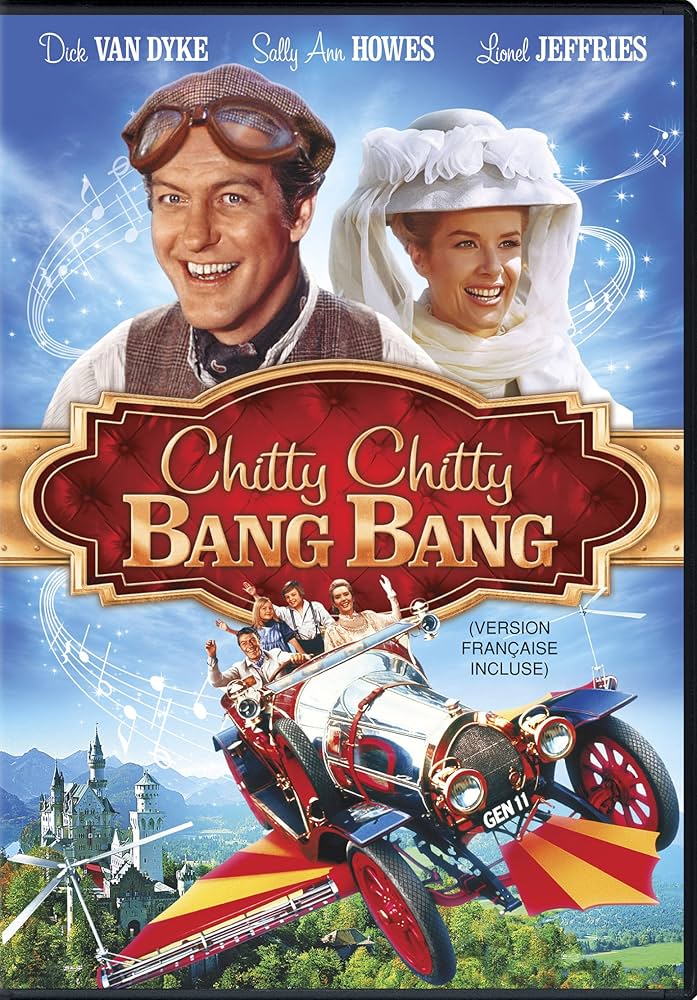
Chitty Chitty Bang Bang is a 1968 musical fantasy comedy film directed by Ken Hughes, produced by Albert R. Broccoli, and starring Dick Van Dyke, Sally Ann Howes, Lionel Jeffries, Gert Fröbe, Anna Quayle, Benny Hill, James Robertson Justice, Robert Helpmann, Heather Ripley and Adrian Hall. The film is based on the 1964 children's novel by Ian Fleming, with a screenplay co-written by Hughes and Roald Dahl.
Irwin Kostal supervised and conducted the music for the film based on songs, written by the Sherman Brothers, Richard and Robert, and the musical numbers were staged by Marc Breaux and Dee Dee Wood.
The film was released in the United Kingdom by United Artists on December 17, 1968, and in the United States on December 18. It was a critical success and was one of the highest-grossing films in the U.S. for 1969. The film's title song was nominated for an Academy Award and Golden Globe Award for Best Original Song, with a second Golden Globe nomination for Best Original Score.
Plot: While truant from school, young siblings Jeremy and Jemima meet the beautiful Truly Scrumptious (Sally Ann Howes), who falls for their widowed father, Caractacus Potts (Dick Van Dyke), and his various oddball inventions, including the family's noisy rebuilt car, Chitty Chitty Bang Bang. One day at the beach, Caractacus tells Truly and the children a fanciful fable about the villainous Baron Bomburst (Gert Frobe) and his evil designs on the Potts family car.
Acting: My favorite title is Chitty Chitty Bang Bang for the following actors.
Dick Van Dyke played Caractacus Potts. Broccoli announced the casting of Dick Van Dyke in December 1966 Van Dyke was cast in the film after he turned down the role of Fagin in the 1968 musical Oliver!. Who doesn't love Dick Van Dyke? I did not realize what the character's first name was until my most recent viewing. His four most notable titles include Mary Poppins, Mary Poppins Returns, Chitty Chitty Bang Bang, and The Dick Van Dyke Show television series.
Sally Ann Howes played Truly Scrumptious. The role of Truly Scrumptious was originally intended for Julie Andrews to reunite her with Van Dyke after their success in Mary Poppins (1964), but Andrews rejected the part because she felt it was too similar to Poppins; Sally Ann Howes, who had replaced Andrews as Eliza Doolittle in My Fair Lady on Broadway in 1958, was then offered the role, and she accepted. She was cast as the female lead in April 1967. She was the perfect substitute for Julie Andrews. If I didn't know any better I would think they were the same person in the way they both look and sound. Her four most notable titles are Paradise Lagoon, Dead of Night, Chitty Chitty Bang Bang, and The Life and Adventures of Nicholas Nickleby.
The children both did extremely well at acting as it was their first movie. Heather Ripley played Jemima Potts. Neither of them acted much after Chitty Chitty Bang Bang.
Minor roles were played by Gert Fröbe played Baron Bomburst; Benny Hill as the Toymaker; Anna Quayle as Baroness Bomburst; James Robertson Justice as Lord Scrumptious; Robert Helpmann as Child Catcher; Barbara Windsor as Blonde at the carnival; Davy Kaye as Admiral; Alexander Doré as First Spy; Bernard Spear as Second Spy; Stanley Unwin as Chancellor; Peter Arne as Captain of the Guard; Desmond Llewelyn as 'Bill' Coggins; Victor Maddern as the Junkman; Arthur Mullard as Big Man (Cyril) at the carnival; George Leech as Chitty's original driver; Richard Wattis as Philips, the secretary at Scrumptious Sweet Co.; and Michael Audreson as Peter, the blond Vulgarian boy.
Background information from American Film Institute (AFI): The Aug. 16 1965 Daily Variety (DV) announced that Albert R. Broccoli and Harry Saltzman, known for co-producing the James Bond series of motion pictures based on Ian Fleming's novels, planned to produce a film adaptation of Fleming's 1964 children's novel, Chitty Chitty Bang Bang. Fleming, who died the year the book was published, had based the work on bedtime stories he had make up for his son, Caspar, involving a magical car named after Count Louis Zborowski's 1920s racing car, "Chitty Chitty Bang Bang." According to a Oct. 22, 1967 New York Times (NYT) article, Albert R. Broccoli was initially uninterested in adapting the book, but changed his mind after the tremendous success of the children's musical comedy Mary Poppins, (which also featured Dick Van Dyke).
The Dec. 14 1965 DV stated that United Artists (UA) would back the picture, then budgeted at $8 million, according to an Nov. 11 1966 DV item. Later figures in the Nov. 20, 1968 DV and Apr. 30 1968 NYT cited a final budget of $10 million, and $12 million, respectively. Earl Hammer, Jr. had finished a script by Dec. 12 1965, as noted in that day's NYT; however, he was replaced by children's author, Roald Dahl, the following year. Dahl had recently scripted the James Bond picture, You Only Live Twice (1967). The final screenplay was described in the Oct. 22 1967 NYT as a "flagrant rewrite" of the original novel. A wife character was excised, making "Caractacus Potts" a widower and allowing for a love story between him and "Truly Scrumptious." Potts' "Toot Sweet" whistling candies were also an invention of the screenwriters. Director Ken Hughes, who received a co-writing credit, complained that Dahl was no longer around at the start of filming and was quoted as saying, "I had to rewrite the whole bleedin' scenario." (I didn't know Roald Dahl helped screen-write movies the first place, very interesting).
Several crewmembers who had worked on Mary Poppins were reassembled for Chitty Chitty Bang Bang, including songwriting brothers Richard M. and Robert B. Sherman, music supervisor and conductor Irwin Kostal, and choreographers Marc Breaux and Dee Dee Wood. Production designer Ken Adam noted in the Oct. 22 1967 NYT that four vehicles were built for the shoot: a worn-out version of "Chitty Chitty Bang Bang"; a restored version made to look like a 1910 racing car (which represented an earlier style than the 1920s Count Zborowski vehicle Fleming had referenced); a speedboat version of the car; and "Baron Brombust's" zeppelin.
Principal photography began in England on Jul. 17 1967, according to a Jul. 21 1967 DV production chart. Interiors were filmed at Pinewood Studios. Location shooting outside England was done in Bavaria, Germany, as stated in the Oct. 4 1967 Var, where the Neuschwanstein Castle stood in for the home of Baron Bomburst, and the town of Rothenberg ob der Tauber provided exteriors. The Dec. 18 1968 Los Angeles Times (LAT) review also listed the south of France as a filming site.
During production, Dick Van Dyke endured a leg injury, the Aug. 30 1967 DV reported. The resulting delays necessitated a seven-day shooting schedule beginning in late Aug. 1967.
Eight months in advance of theatrical release, a "teaser" advertising campaign was launched in late Apr. 1968 in 16 cities, as stated in a Apr. 30 1968 NYT article. The week-long promotional campaign cost UA $620,000, and a studio executive claimed it was the largest advertising effort done by any studio that far in advance of a motion picture release. The Nov. 3 1968 NYT stated that roughly 150 tie-in items would be marketed around the release, including model cars, General Foods and Campbell Soup products, apparel, and "35 to 40 different versions of the book" to be published by various outlets such as Random House, Signet, the Scholastic Book Service, and Western Publishing Company.
Sally Ann Howes and child co-stars Heather Ripley and Adrian Hall were scheduled to appear on a "Chitty Chitty Bang Bang" -themed float at the Macy's Thanksgiving Day Parade in New York City, according to a Nov. 13 1968 Variety (Var) item. (That's so cool! I would've loved to see that!)
The Jul. 19 1968 DV stated that, "in an unusual move," Columbia Records would release a recording of the Sherman Brothers song, "Hushabye Mountain," by Tony Bennett before Sep. 1 1968, when the remaining 12 songs from the soundtrack would be released. Weeks later, the Aug. 12 1968 DV reported that UA Records, and her first recording would be an album of the Chitty Chitty Bang Bang score.
Advance ticket sales for Chitty Chitty Bang Bang set a record in the U.K. for UA, reaching $108,000 by Dec. 13 1968, as reported in that day's DV. After 23 weeks in release in the U.S., a Aug. 6 1959 Var box-office chart listed the picture's cumulative earnings in five cities as $3,616,170.
A musical based on the film was produced by Albert R. Broccoli's widow, Dana Broccoli, and daughter, Barbara Broccoli. It premiered in London, England, on Apr. 16, 2002, as noted in a Apr. 22 2002 Var review. Three years later, the musical had its Broadway debut on Apr. 28 2005 at the Hilton Theatre, where it ran until Dec. 31 2005.
Final Thoughts: Chitty Chitty Bang Bang is one of my favorite movies from my childhood. It's a longer movie, but it's so entertaining. I really think anyone could enjoy it.
My favorite scene was where the Baron and Baroness perform a duet while the Baron tries and fails multiple times to kill his wife.
My favorite quote is "Oh, a man should have his dreams, but a man has to learn to put those dreams to some practical use; not just sit around and think about them all the time." —Caracticus Potts.
Rated: G
Where to watch it: According to Google, Chitty Chitty Bang Bang is currently available on YouTube, Tubi, Pluto TV, The Roku Channel, and Amazon Prime Video for free, or on YouTube TV with a subscription. You can also purchase or rent a digital copy for a few dollars. I've also donated a DVD copy of the film to the Emil M. Larson Public Library in Clark for you all to enjoy if you choose to.