Introduction
Welcome to my corner! This week, I'm diving deeper into a movie I first mentioned in my November 20, 2024 column: What Ever Happened to Baby Jane? I had just started writing these movie review columns, so I wasn't in the groove yet. That's why I'd like to revisit this movie and a few others from my column's past. This is a great movie to start spooky season. Enjoy!
What Ever Happened to Baby Jane?
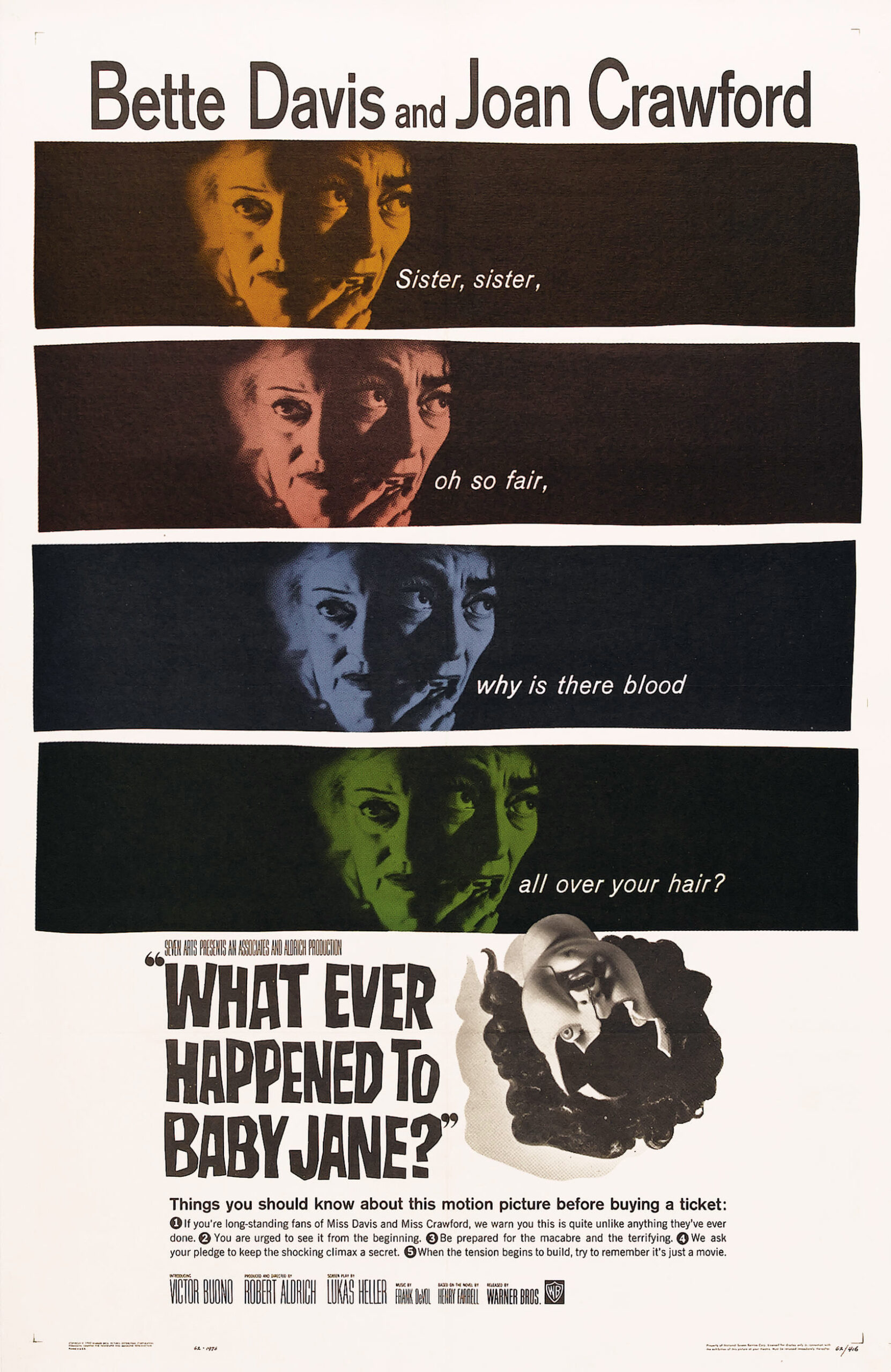
What Ever Happened to Baby Jane? is a 1962 American psychological horror thriller film directed and produced by Robert Aldrich, and starring Bette Davis and Joan Crawford, and featuring Victor Buono in his major film debut. The screenplay, adapted by Lukas Heller from the novel of the same name by Henry Farrell, follows an aging former child star tormenting her paraplegic sister, also a former star, in a dilapidated Hollywood mansion.
The film was shot in Los Angeles in the summer of 1962 on a budget of approximately $1 million. The production was marked by rumors of on-set feuds between Davis and Crawford, though the actresses later denied them. Distributed by Warner Bros. Pictures, What Ever Happened to Baby Jane? premiered in Cincinnati on October 31, 1962, and opened the following week in various U.S. cities. The film earned critical acclaim and was a box-office success. It earned five Academy Award nominations and won one for Best Costume Design, Black-and-White, with Davis receiving her 10th and final nomination for Best Actress.
The alleged bitter rivalry between the two stars, Davis and Crawford, was pivotal to the film's initial success, which helped revitalize their careers. In the years after release, critics continued to acclaim the film for its psychologically driven black comedy, camp, and creation of the psycho-biddy subgenre. (HA!) The film's controversial content led to an X rating in the United Kingdom. Because of the film's stars' appeal, Dave Itzkoff of The New York Times has identified it as a "cult classic."
In 2003, the character of Baby Jane Hudson was ranked no. 44 on the American Film Institute's list of the 50 Best Villains of American Cinema. In 2021, the film was selected for preservation in the United States National Film Registry by the Library of Congress as being "culturally, historically, or aesthetically significant."
Plot: Jane Hudson (Bette Davis) is an aging child star left to care for her wheelchair-bound sister Blanche (Joan Crawford), also a former child actress and stuck living together in a mansion in old Hollywood; Blanche plots to get even with Jane for the car crash that left her crippled years earlier. But Jane is desperate to keep Blanche imprisoned as she plans a new rise to fame, and tries to hide Blanche's existence from doctors, visitors, an neighbors while she devises a way to get rid of her sister.
Acting: My favorite title is What Ever Happened to Baby Jane? for the following actors, if not stated otherwise.
Bette Davis played Jane Hudson. Her four most notable titles include All About Eve, Dark Victory, What Ever Happened to Baby Jane?, and The Man Who Came to Dinner.
Joan Crawford played Blanche Hudson. Her four most notable titles are Mildred Pierce, Humoresque, What Ever Happened to Baby Jane?, and Rain.
Victor Buono played Edwin Flagg. The Sep 15, 1962 Los Angeles Times (LAT) revealed that actor Victor Buono obtained the role of "Edwin Flagg" through a "connection" he made at the Golden Door spa in San Marcos, CA. His brief appearance in the film effectively launched his career as a character actor, as noted in the Jul 1, 1963 LAT. His four most notable titles include Beneath the Planet of the Apes, 4 for Texas, What Ever Happened to Baby Jane?, and Robin and the 7 Hoods.
Minor roles were played by Julie Allred as 9-year-old Jane; Debbie Burton as young Jane's singing voice; Gina Gillespie as 13-year-old Blanche; Wesley Addy as Marty McDonald; Anne Barton as Cora Hudson; Marjorie Bennett as Dehlia Flagg; Bert Freed as Ben Golden; Anna Lee as Mrs. Bates; Maidie Norman as Elvira Stitt; Dave Willock as Ray Hudson; Ernest Anderson as Ernie the ice-cream vendor; Russ Conway as police officer; Maxine Cooper as bank teller; Robert Cornthwaite as Doctor Shelby; Michael Fox as TV commercial man; B.D. Merrill as Liza Bates; Don Ross as police officer; James Seay as police officer; John Shay as police officer; Jon Sheppod as police officer; Peter Virgo as police officer; Bobs Watson as clerk in newspaper classified ad department.
Background information from American Film Institute (AFI): On Mar 3, 1960, New York Times (NYT) announced the publication of Henry Farrell's novel, What Ever Happened to Baby Jane? Three weeks later, on Mar 25, 1960, the LAT reported that producer Richard Rush was negotiating for motion picture rights, with plans to star Hugh O'Brian, Agnes Moorehead, and Jennifer West. The project remained in limbo until Sep 6, 1961, when Variety (Var) stated that Robert Aldrich would direct the film for producer Joseph E. Levine's Embassy Pictures. On Oct. 4, 1961, Var reported that actress Joan Crawford was meeting with Aldrich that day to discuss her role. The film would mark her first screen appearance in several years; her last was Autumn Leaves (1956), also directed by Aldrich. In the Jan. 15, 1962 LAT, columnist Hedda Hopper announced that Crawford would co-star with Bette Davis, marking the first screen collaboration between the two veteran actresses. The Mar 14, 1962 NYT reported that Davis was leaving the Broadway cast of Night of the Iguana and would begin rehearsals for the film in Los Angeles, CA, after a brief hiatus. The May 19, 1962 NYT revealed that Crawford approached Aldrich several years earlier, suggesting he make a film starring her and Davis. Although the director rejected Crawford's story, he was intrigued by the idea of co-starring the two actresses. Aldrich told the Jul 29, 1962 NYT that he and Crawford continued to search for a suitable property over the previous three years until both agreed on What Ever Happened to Baby Jane? The director then commissioned Lukas Heller to write the screenplay, which Davis later approved. Seven Arts Productions arranged financing, with Warner Bros. Pictures handling distribution. Filming took place at the Producers Studio, later known as Raleigh Studios, in Los Angeles. The $600,000 production was to be finished in 30 days. Following completion, the May 29, 1963, Var estimated the budget at $800,000. Coincidentally, both Crawford (born 1904) and Davis (born 1908) were the exact ages of the characters they portrayed.
According to the Jul 14, 1962 NYT, principal photography was scheduled to begin Jul 23, 1962. Aldrich stated in the Jan. 23, 1963, Var that both actresses were offered handsome salaries, although neither was paid her standard rate. The studio compensated by giving Davis 10% of net profits and Crawford 15%, resulting in salaries exceeding $500,000 after successful box-office returns. Although Davis had faith in the picture, she compared being paid in net profits to gambling.
Crawford dispelled rumors of a feud between her and Davis, explaining that she had wanted to collaborate with her co-star since 1944, when they were both under contract to Warner Bros. Producer William Frye recommended the source novel to Davis two years earlier but couldn't secure motion picture rights. Davis then offered the story to director Alfred Hitchcock, but he had other commitments. The Oct 24, 1962 Var later quoted Davis from a television interview, saying the two women had "too much pride to quarrel." The Aug. 22, 1962 Var confirmed the friendly on-set atmosphere.
The Nov 21, 1962 Var reported that the picture was currently playing in 19 "key cities," and was the second highest-earning release in the country. On Feb. 13, 1963, Var estimated gross receipts of $4 million. A news item in the Aug. 28, 1963, Var noted that Seven Arts recovered production costs within the first 11 days of the film's initial New York City opening. Aldrich planned another vehicle for Crawford and Davis, What Ever Happened to Cousin Charlotte? Later retitled Hush... Hush, Sweet Charlotte (1964).
What Ever Happened to Baby Jane? received Academy Award nominations for Best Performance by an Actress (Bette Davis); Best Achievement in Cinematography, Black-and-White (Ernest Haller); Best Achievement in Costume Design, Black-and-White (Norma Koch). Only Koch won the award.
Final Thoughts: As I said in my previous column, What Ever Happened to Baby Jane? is a disturbing movie, to say the least, but that's why it's a psychological thriller. These types of movies certainly aren't for everyone, but it is a perfect movie for October.
What Ever Happened to Baby Jane? is an extreme example of what could happen to child stars, and why child stardom is hazardous if not approached right. Honestly, Baby Jane didn't have a chance, given the way her parents, mostly her father, treated her.
I didn't like how the movie portrays Blanche as helpless because she was paralyzed and in a wheelchair. She's been that way for years, but she never moved her bedroom to the ground floor, put in a ramp, or even figured out how to get around and do things for herself a little more. Of course, keeping Blanche helpless helped Jane keep her locked up and away from the world, but that's not how it all started.
All the characters in this movie are exceedingly dumb. If they had approached certain situations differently, things would've turned out much better. It baffles me that no one trusted Jane because they all knew she was cuckoo, but believed her words about Blanche anyway. What!? Blanche especially took too long to act, and when she did, she went about it wrong every time. Too bad 911 emergency calling wasn't a thing until 1968.
My favorite scene was when Jane met Edwin Flagg after placing a newspaper ad for help with music composition. Edwin came to the house, and their interaction at the door was hilariously awkward.
My favorite quote is "You can lose everything else, but you can't lose your talent..." —Jane, reminiscing about her dad.
Rated: Not rated.
Where to watch it: According to Google, What Ever Happened to Baby Jane? is currently available on YouTube, Tubi, and PLEX for free or on YouTube TV with a subscription. You can also purchase or rent a digital copy for a few dollars. I've also donated a DVD copy of the film to the Emil M. Larson Public Library in Clark for you all to enjoy if you choose to.