
Introduction
Welcome to my corner! This week, I'm sharing my thoughts on the film Bad Day at Black Rock. The TCM television channel played it on July 28, 2025. I recorded it then and just got around to watching it recently. Enjoy!
Bad Day at Black Rock
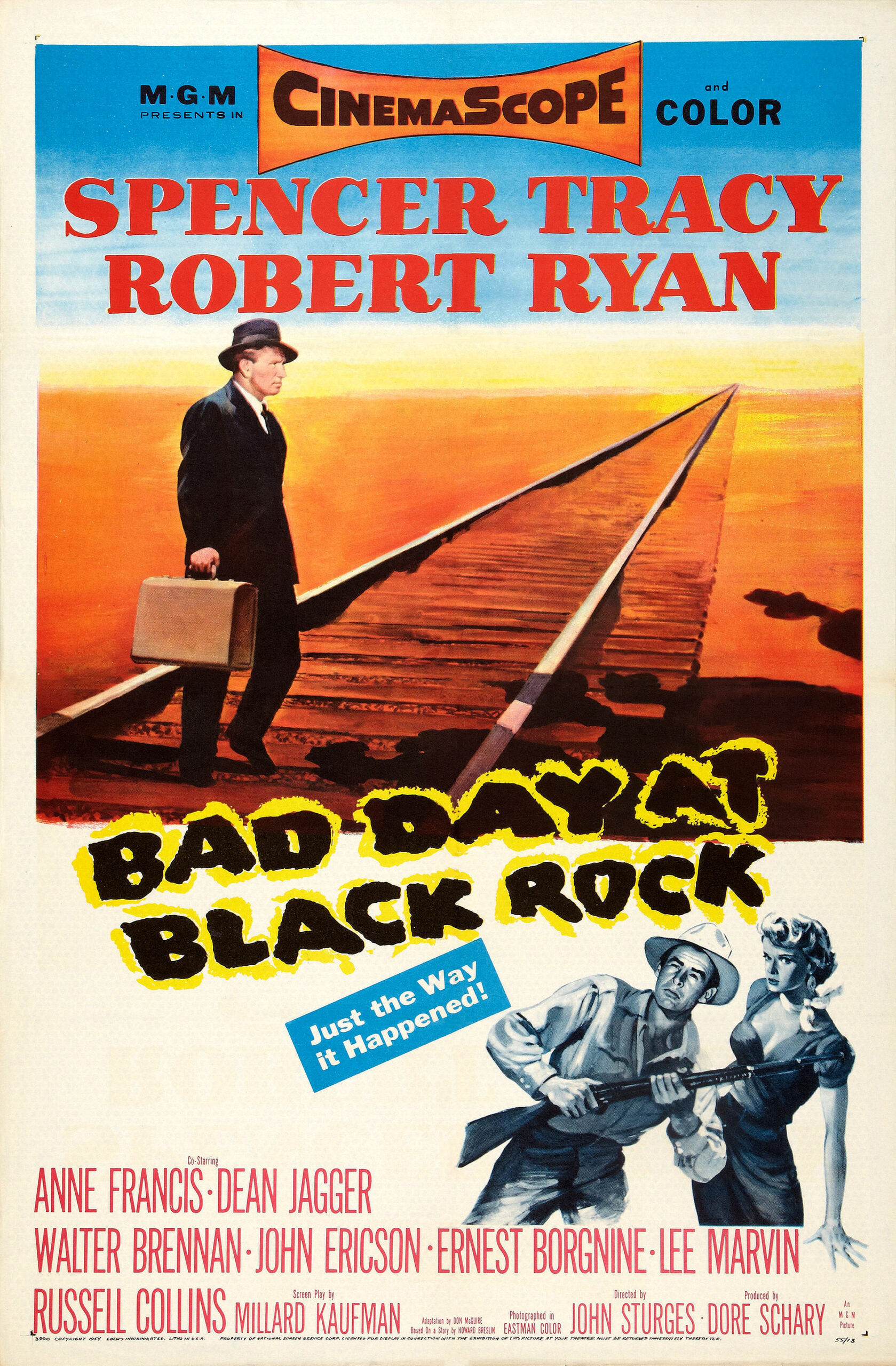
Bad Day at Black Rock is a 1955 American neo-Western film noir directed by John Sturges and written by Millard Kaufman. It stars Spencer Tracy and Robert Ryan with support from Anne Francis, Dean Jagger, Walter Brennan, John Ericson, Ernest Borgnine, and Lee Marvin. The film is a crime drama set in 1945 that contains elements of the revisionist Western genre. In the plot, a one-armed stranger (Tracy) comes to a small desert town and uncovers an evil secret that has corrupted the entire community.
The film is based on the short story "Bad Time at Honda" by Howard Breslin, published in The American Magazine in January 1947. Filming began in July 1954, and the movie went on national release in January 1955. It was a box-office success and was nominated for three Academy Awards in 1956. In 2018, it was selected for preservation in the United States National Film Registry by the Library of Congress as being "culturally, historically or aesthetically significant."
Plot: When John J. Macreedy (Spencer Tracy), a one-armed war veteran, arrives in the small desert town of Black rock, he's not greeted warmly. Searching for a man named Komoko, Macreedy is met with disdain by virtually every local, including the resident thug, Hector David (Lee Marvin) and the imposing Reno Smith (Robert Ryan). As Macreedy's investigation deepens, hostility turns to violence — and to imminent danger for the mysterious and inquisitive stranger.
Acting: Spencer Tracy played John J. Macreedy. There's a reason why he was a big star that everybody wanted for their pictures. He's just that good. I love Spencer Tracy and watching him act, particularly in his later years. I love that he just keeps his left hand in his pocket the whole movie to convey being disabled. It's the easiest thing. His four most notable titles include Guess Who's Coming to Dinner, Judgment at Nuremberg, Bad Day at Black Rock and Inherit the Wind. My favorite so far is Father of the Bride.
Robert Ryan played Reno Smith. He played a good bad guy. Looks like he was in a lot of westerns. His four most notable titles are The Wild Bunch, The Dirty Dozen, Bad Day at Black Rock and Clash By Night. I haven't seen his other work.
Minor roles were played by: Anne Francis as Liz Wirth; Walter Brennan as Doc Velie; Ernest Borgnine as Coley Trimble; Dean Jagger as Sheriff Tim Horn; John Ericson as Pete Wirth; Lee Marvin as Hector David; Russell Collins as Mr. Hastings; and Walter Sande as Sam, the diner owner.
Technical Aspects: Bad Day at Black Rock originated as a short story by Howard Breslin with full-color illustrations by Robert Fawcett. Titled "Bad Time at Honda", it was published by The American Magazine in January 1947. It was adapted into a script by Don McGuire and pitched into Metro-Goldwyn-Mayer production head Dore Schary, who was known for championing films that addressed social problems. Schary had previously produced Go for Broke! (1951), based on the exploits of the segregated Japanese-American 442nd Regimental Combat Team. Breslin novelized the script, using the pseudonym Michael Niall. His book was published in 1954 by Fawcett Publications.
Schary acquired the film rights for Metro-Goldwyn-Mayer, but he hired Millard Kaufman to rewrite McGuire's script. The producers were worried about the title because "Bad Time at Honda" was similar to Hondo, a recent John Wayne film. Kaufman suggested changing the town's name to Black Rock, after a real town in Arizona. Kaufman finished the script in the fall of 1953.
Although Spencer Tracy was 54 and much older than the platoon leader in the original story, Schary wanted Tracy to play the lead role. John Sturges was hired as director in June 1954, and shooting began in the following month near Lone Pine, Calif., where the small-town set had been quickly built. Just before shooting began, an indecisive Tracy tried to back out of the picture. Schary made it clear that he would sue the actor if the actor quit the film. After 20 years with MGM, Bad Day at Black Rock was Tracy's final film for the studio, except for How the West Was Won (1963), for which he provided the narration.
The film was budgeted at $1.3 million and shot in Eastmancolor using Cinemascope because Schary thought that widescreen would emphasized the menace of the isolated town. Temperatures on location were over 100 °F (38 °C). On August 9, the cast and crew relocated to the MGM studio lot in Culver City. André Previn was hired to write the score.
Although the film was essentially a crime drama set in 1945, it is generally regarded as a neo-Western, with strong links to the revisionist Western genre. The premiere was at Loew's 72nd Street Theatre in New York City on December 8, 1954. The film was released nationally in January 1955. According to MGM records, it earned $1,966,000 in the U.S. and Canada and $1,822,000 elsewhere, resulting in a profit of $947,000.
The plot of the movie—a small western desert town hiding a guilting secret and protecting a local person from outside law enforcement—became a common trope in crime shows on U.S. television. Detective and crime series as diverse as Cannon, Kojak, The A-Team and Remington Steele, among others, each had an episode with a plot similar to Bad Day at Black Rock. In the case of Kojak and Remington Steele, the film is actually mentioned in the dialogue of the episodes.
From TCM: Director John Sturges was a master of suspenseful, well-crafted westerns and action/adventure films. And Bad Day at Black Rock (1955), the story of a hate crime in a small western town, and the bullying attempts by some townspeople to keep an outsider from finding out, certainly fits comfortably into those boundaries. That it also transcends them is not surprising, given the film's history.
Bad Day at Black Rock was made at a time of professional and political upheaval in Hollywood. In 1951, Dore Schary had replaced Louis B. Mayer as head of MGM. Schary, politically liberal, produced "message pictures" reflecting his beliefs. This was the era of blacklisting, of the McCarthy witch hunts, when even the hint of communist affiliation could destroy careers. Bad Day at Black Rock's contemporary western was the kind of allegory that Schary liked. In fact, he liked it so much that Schary himself replaced Charles Schnee as producer. Richard Brooks, no stranger to message pictures, was set to direct.
Now that the film was shaping up to be an "important" picture, Schary needed a heavyweight star to play John MacReedy, the World War II veteran who stands up to the town. He went after Spencer Tracy, who was reluctant. What finally clinched Tracy was an excellent script revision by Millard Kaufman... and Schary's lie that Alan Ladd was interested in the role.
To keep Tracy happy, Schary also replaced Brooks with John Sturges, who had directed Tracy in The People Against O'Hara (1951). Sturges brought his talent for suspense and action, his skill at choreographing violence and his eye for casting to Bad Day at Black Rock. Ernest Borgnine and Lee Marvin both received career boosts from the film. Borgnine's next film, Marty (1955), won him an Oscar—beating Tracy, who was nominated for Bad Day at Black Rock.
Bad Day at Black Rock was a commercial and critical success. Reviews at the time praised its message of civic responsibility, individual integrity and the dangers of group complacency. Film historians now also see it as an indictment of the blacklist in Hollywood.
Final Thoughts: I want to know how a hotel can stay open when the town doesn't allow any snooping strangers. Really, how do any of the businesses stay open with fewer than 10 people in town? Holy Mackerel.
Bad Day at Black Rock has been on my list for a while, and I finally got around to watching it. I wasn't disappointed. I don't think you'll be disappointed, either.
My favorite scene (and probably everybody's favorite scene) was the fight scene between Spencer Tracy and Ernest Borgnine.
My favorite quote is "Well, I know this much: the rule of law has left here, and the gorillas have taken over." —John J. Macreedy.
Where to watch it: According to Google, Bad Day at Black Rock is currently available on Tubi. You can also purchase or rent a digital copy for a few dollars. I've also donated a DVD copy of the film to the Emil M. Larson Public Library in Clark for you all to enjoy, if you choose.